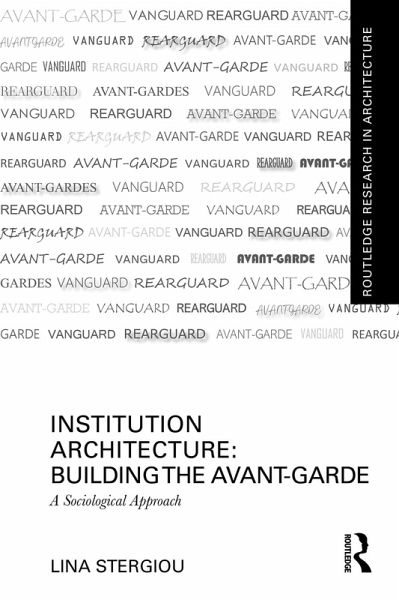
Institution Architecture: Building the Avant-Garde (eBook, PDF)
A Sociological Approach
Versandkostenfrei!
Sofort per Download lieferbar
39,95 €
inkl. MwSt.
Weitere Ausgaben:

PAYBACK Punkte
20 °P sammeln!

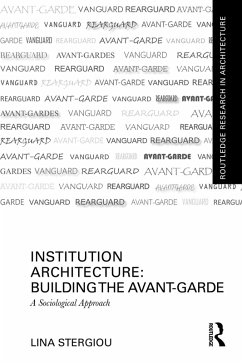
Institution Architecture: Building the Avant-Garde takes a terminological, sociological, and semiological approach that develops by tracing the 'avant-garde' in a century span of literatures for a textual analysis, unpacking the text, and in a process analysis, interpreting it.The sources consist of 825 well-known, globally influential European, including Russian, architectural literatures of the extended 1920s, and of Anglo-Saxon literatures of the extended 1960s to the 2010s. The book traces the connotations that the term 'avant-garde' acquired in them and shows the different notions under t...
Institution Architecture: Building the Avant-Garde takes a terminological, sociological, and semiological approach that develops by tracing the 'avant-garde' in a century span of literatures for a textual analysis, unpacking the text, and in a process analysis, interpreting it.
The sources consist of 825 well-known, globally influential European, including Russian, architectural literatures of the extended 1920s, and of Anglo-Saxon literatures of the extended 1960s to the 2010s. The book traces the connotations that the term 'avant-garde' acquired in them and shows the different notions under the 'avant-garde' signifier, directing attention to the term's early twentieth-century roots and modes; its 1960s rising usage, modes, and function; and its post-1960s to 2010s developments. It sheds light on the sociological topography of the avant-garde, and through the writings, on the ways in which the term and avant-gardism connected, the actors, agencies, and mediators therein, on the terms' techniques and modes, indicating the reasons for its heretofore limited systematic inquiry. The book aims at unravelling a century-old 'avant-garde' mystic function for unlocking horizontal, plural, and transparent conversations about interdisciplinary futures of architecture, cross-disciplinary dialogues, and liberatory dynamics. The book will therefore be relevant to scholars and researchers interested in the avant-garde in architecture, and the avant-garde as a transdisciplinary subject.
The sources consist of 825 well-known, globally influential European, including Russian, architectural literatures of the extended 1920s, and of Anglo-Saxon literatures of the extended 1960s to the 2010s. The book traces the connotations that the term 'avant-garde' acquired in them and shows the different notions under the 'avant-garde' signifier, directing attention to the term's early twentieth-century roots and modes; its 1960s rising usage, modes, and function; and its post-1960s to 2010s developments. It sheds light on the sociological topography of the avant-garde, and through the writings, on the ways in which the term and avant-gardism connected, the actors, agencies, and mediators therein, on the terms' techniques and modes, indicating the reasons for its heretofore limited systematic inquiry. The book aims at unravelling a century-old 'avant-garde' mystic function for unlocking horizontal, plural, and transparent conversations about interdisciplinary futures of architecture, cross-disciplinary dialogues, and liberatory dynamics. The book will therefore be relevant to scholars and researchers interested in the avant-garde in architecture, and the avant-garde as a transdisciplinary subject.
Dieser Download kann aus rechtlichen Gründen nur mit Rechnungsadresse in A, B, BG, CY, CZ, D, DK, EW, E, FIN, F, GR, HR, H, IRL, I, LT, L, LR, M, NL, PL, P, R, S, SLO, SK ausgeliefert werden.
Andere Kunden interessierten sich für