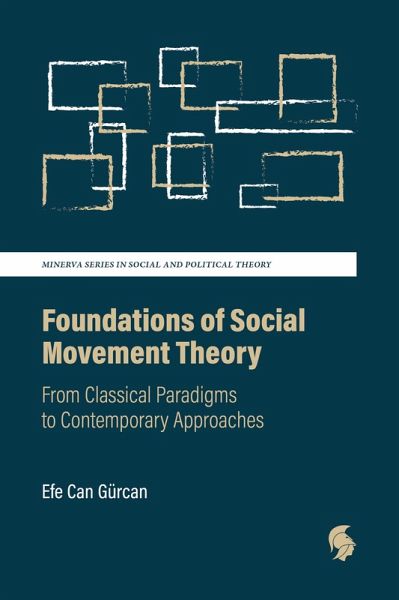
Foundations of Social Movement Theory (eBook, ePUB)
From Classical Paradigms to Contemporary Approaches

PAYBACK Punkte
0 °P sammeln!

This book offers a rigorous intellectual roadmap to the core traditions that have shaped the modern study of collective action. It argues that understanding how ordinary people transform society requires starting from theory-not as abstraction, but as an analytic toolkit for interpreting protest, organization, and resistance. Throughout the book, theoretical debates are consistently grounded in concrete cases, ranging from climate strikes and feminist mobilizations to anti-racist uprisings, labor movements, and digital campaigns, demonstrating why strong theoretical grounding remains indispens...
This book offers a rigorous intellectual roadmap to the core traditions that have shaped the modern study of collective action. It argues that understanding how ordinary people transform society requires starting from theory-not as abstraction, but as an analytic toolkit for interpreting protest, organization, and resistance. Throughout the book, theoretical debates are consistently grounded in concrete cases, ranging from climate strikes and feminist mobilizations to anti-racist uprisings, labor movements, and digital campaigns, demonstrating why strong theoretical grounding remains indispensable. Moving in a broadly historical and genealogical arc, the book traces the field from Cold War-era collective behavior and structural-strain approaches to the breakthroughs of Resource Mobilization and Political Process theories. It then examines the cultural turn through framing and identity-based perspectives, the emergence of New Social Movements, and the synthesis attempted by the contentious politics paradigm. A final chapter turns to contemporary Marxist and critical political economy approaches, reconnecting social movement theory with questions of capitalism, empire, and global inequality. Rather than an exhaustive survey, this volume mostly concentrates on the foundational canon-those frameworks that continue to structure how scholars ask questions, design research, and interpret movements in an age of digital activism, transnational networks, and Global South uprisings. It is an essential point of departure for students and researchers seeking a deep, conceptually grounded entry into social movement studies, while also equipping advanced scholars with a refined theoretical architecture for re-evaluating established paradigms and engaging emerging questions in the field.
Dieser Download kann aus rechtlichen Gründen nur mit Rechnungsadresse in A, B, BG, CY, CZ, D, DK, EW, E, FIN, F, GR, H, IRL, I, LT, L, LR, M, NL, PL, P, R, S, SLO, SK ausgeliefert werden.
Andere Kunden interessierten sich für