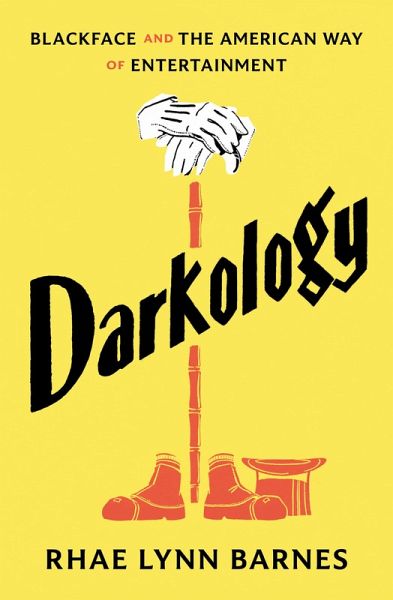
Darkology (eBook, ePUB)
Blackface and the American Way of Entertainment
Erscheint vor. 24.03.26
20,95 €
inkl. MwSt.
Unser Service für Vorbesteller - dein Vorteil ohne Risiko:
Sollten wir den Preis dieses Artikels vor dem Erscheinungsdatum senken, werden wir dir den Artikel bei der Auslieferung automatisch zum günstigeren Preis berechnen.
Weitere Ausgaben:

PAYBACK Punkte
10 °P sammeln!

A groundbreaking history, decades in the making, that chronicles how blackface dominated American society culturally, financially, and racially for nearly two centuries. Never before has the disturbing story of blackface and its piercing reflection of American society been so comprehensively told. With?Darkology, Princeton historian Rhae Lynn Barnes meticulously unravels the complex, subterranean, and all-too-often expunged history of Darkologythe insidious study, commodification, and dehumanization of Black life, through which performers caricatured the enslaved and formerly enslaved for thei...
A groundbreaking history, decades in the making, that chronicles how blackface dominated American society culturally, financially, and racially for nearly two centuries.
Never before has the disturbing story of blackface and its piercing reflection of American society been so comprehensively told. With?Darkology, Princeton historian Rhae Lynn Barnes meticulously unravels the complex, subterranean, and all-too-often expunged history of Darkologythe insidious study, commodification, and dehumanization of Black life, through which performers caricatured the enslaved and formerly enslaved for their supposed subservience and happy demeanor.
Given the extraordinary research reflected in Darkology, it's not surprising that Barnes spent twenty years tracking down fading photographs, old movies, bureaucratic detritus, moldy scripts, and living witnesses, assembling an impressive archive that allowed her to demonstrate the astonishingly broad reach of blackface minstrelsy (Laurel Thatcher Ulrich). Painstakingly piecing together these scattered shards of evidence, Barnes reveals the shocking extent to which blackface took center stage in every era of American history.
This was not a fringe activity. By 1830, as political resistance to slavery grew, blackface exploded from a niche performance into a venomous national export. Within a decade, hardly a theater in the country didn't put on minstrel shows. Following the Civil War, this grotesque entertainment soared, seeping from professional theaters into everyday amateur shows, print, and advertisements. It was everywhere: Elks Clubs, religious institutions, battlefields, universities, and schools. It wasn't just in the Jim Crow era; it defined it. The very name Jim Crow derives from minstrelsy's founding character.
Darkology dismantles the myth that blackface was a fleeting, postCivil War phenomenon. Even in eras known for liberal progressivism, it flourished. Barnes unearths the startling fact that four-term president Franklin D. Roosevelt was a devotee who died hours before a blackface show he had commissioned at Warm Springs. It permeated U.S. military bases and was even used in World War II Japanese American concentration camps and German POW camps as a bizarre tool of Americanization.
After WWII, the tide began to turn as Black veterans and mothers in places like suburban California protested the practice in schools. Still, blackface performances proved resilient, surfacing as late as 1969 at the University of Vermont. Even as the Civil Rights movement fought for equality, blackface remained present in American politics and white supremacist organizing through the Nixon and Ford administrations, its legacy still percolating in variable forms today.
By tracing minstrelsy's evolution through oral histories, material culture, and a wide range of multimedia sources, Barnes's masterpiece (David Blight) forces us to reckon with the myriad ways the American Dream wore blackface. Recasting this American story with vivid and engaging storytelling (Howard French), Darkology is a landmark work that peers beneath the boulders deliberately obscuring our pastilluminating a path toward a more just and equal society in America's future.
Never before has the disturbing story of blackface and its piercing reflection of American society been so comprehensively told. With?Darkology, Princeton historian Rhae Lynn Barnes meticulously unravels the complex, subterranean, and all-too-often expunged history of Darkologythe insidious study, commodification, and dehumanization of Black life, through which performers caricatured the enslaved and formerly enslaved for their supposed subservience and happy demeanor.
Given the extraordinary research reflected in Darkology, it's not surprising that Barnes spent twenty years tracking down fading photographs, old movies, bureaucratic detritus, moldy scripts, and living witnesses, assembling an impressive archive that allowed her to demonstrate the astonishingly broad reach of blackface minstrelsy (Laurel Thatcher Ulrich). Painstakingly piecing together these scattered shards of evidence, Barnes reveals the shocking extent to which blackface took center stage in every era of American history.
This was not a fringe activity. By 1830, as political resistance to slavery grew, blackface exploded from a niche performance into a venomous national export. Within a decade, hardly a theater in the country didn't put on minstrel shows. Following the Civil War, this grotesque entertainment soared, seeping from professional theaters into everyday amateur shows, print, and advertisements. It was everywhere: Elks Clubs, religious institutions, battlefields, universities, and schools. It wasn't just in the Jim Crow era; it defined it. The very name Jim Crow derives from minstrelsy's founding character.
Darkology dismantles the myth that blackface was a fleeting, postCivil War phenomenon. Even in eras known for liberal progressivism, it flourished. Barnes unearths the startling fact that four-term president Franklin D. Roosevelt was a devotee who died hours before a blackface show he had commissioned at Warm Springs. It permeated U.S. military bases and was even used in World War II Japanese American concentration camps and German POW camps as a bizarre tool of Americanization.
After WWII, the tide began to turn as Black veterans and mothers in places like suburban California protested the practice in schools. Still, blackface performances proved resilient, surfacing as late as 1969 at the University of Vermont. Even as the Civil Rights movement fought for equality, blackface remained present in American politics and white supremacist organizing through the Nixon and Ford administrations, its legacy still percolating in variable forms today.
By tracing minstrelsy's evolution through oral histories, material culture, and a wide range of multimedia sources, Barnes's masterpiece (David Blight) forces us to reckon with the myriad ways the American Dream wore blackface. Recasting this American story with vivid and engaging storytelling (Howard French), Darkology is a landmark work that peers beneath the boulders deliberately obscuring our pastilluminating a path toward a more just and equal society in America's future.
Dieser Download kann aus rechtlichen Gründen nur mit Rechnungsadresse in A, D ausgeliefert werden.
Andere Kunden interessierten sich für