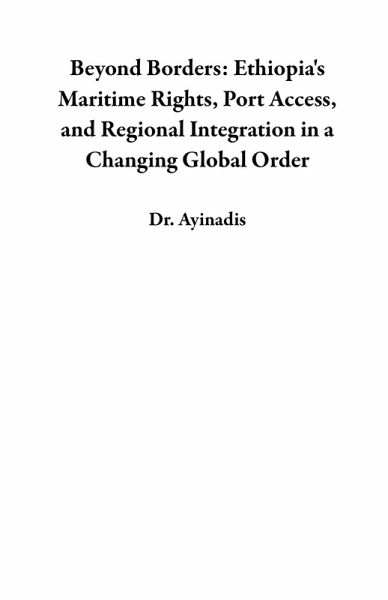
Beyond Borders: Ethiopia's Maritime Rights, Port Access, and Regional Integration in a Changing Global Order (eBook, ePUB)

PAYBACK Punkte
0 °P sammeln!

Since the independence of Eritrea in 1993, Ethiopia's geopolitical identity and economic stability have been fundamentally reshaped by its landlocked status. This comprehensive and multidisciplinary study delves into the critical question of Ethiopia's maritime access, a challenge rooted in decades of historical evolution and complicated by shifting dynamics in the Horn of Africa. Once a sovereign state with continuous access to the Red Sea via the vital ports of Assab and Massawa-an arrangement established from the UN-mandated federation in 1952 until Eritrea's secession-Ethiopia now operates...
Since the independence of Eritrea in 1993, Ethiopia's geopolitical identity and economic stability have been fundamentally reshaped by its landlocked status. This comprehensive and multidisciplinary study delves into the critical question of Ethiopia's maritime access, a challenge rooted in decades of historical evolution and complicated by shifting dynamics in the Horn of Africa. Once a sovereign state with continuous access to the Red Sea via the vital ports of Assab and Massawa-an arrangement established from the UN-mandated federation in 1952 until Eritrea's secession-Ethiopia now operates under the severe constraints of a corridor-dependent economy.The economic stakes are immense. With more than 95 percent of its import-export traffic channeled through the Port of Djibouti, the country faces profound structural dependency and escalating logistics costs that impede its economic trajectory and regional ambition. This reliance creates significant strategic vulnerability, necessitating urgent re-evaluation of its foreign policy and long-term development plans.Author Ayinadis Tilahun Woldetsadik (Dr.) navigates the complex history of this problem, tracing the loss of maritime access not to a simple diplomatic setback, but to a legacy of colonial-era boundary arrangements and the post-independence principle of uti possidetis juris, which formalized Eritrea's coastline under a new sovereign state. The analysis rigorously revisits key moments in this historical trajectory, from the Hewett Treaty of 1884 to the pivotal UN Resolution 390 (A) (V) of 1950 and the subsequent annexation of Eritrea in 1962.The study masterfully integrates various fields to construct a holistic view:•International Legal Frameworks: Assessing Ethiopia's rights under the United Nations Convention on the Law of the Sea (UNCLOS).•Economic Assessments: Quantifying the costs of dependency and evaluating the feasibility of alternative port and corridor options.•Geopolitical Dynamics: Analyzing regional integration strategies necessary for peace and mutual prosperity in a highly militarized Red Sea zone.Beyond Borders is an essential read for policymakers, scholars of African history, and international relations specialists seeking to understand how the world's most populous landlocked country is attempting to redefine its strategic position and secure its future in a turbulent global order. It offers critical insight into the urgent need for a new framework for port access and regional integration that extends beyond current diplomatic arrangements
Dieser Download kann aus rechtlichen Gründen nur mit Rechnungsadresse in A, B, CY, CZ, D, DK, EW, E, FIN, F, GR, H, IRL, I, LT, L, LR, M, NL, PL, P, R, S, SLO, SK ausgeliefert werden.
Andere Kunden interessierten sich für