Begin Remote Viewing (eBook, ePUB)
Sofort per Download lieferbar
7,99 €
inkl. MwSt.

PAYBACK Punkte
0 °P sammeln!

Begin Remote Viewing is a practical, no-drama guide to a craft that's been wrapped in legend and arguments for fifty years-and doesn't need either to work. Instead of selling you fireworks, this book teaches you how to aim attention on purpose, describe what you sense before you name it, keep honest notes, and reveal feedback on time. If you can make small promises and keep them, you can learn remote viewing.You won't be asked to adopt a belief. You'll be asked to run clean procedures. At the heart of the method is a boring, beautiful sentence: describe an unknown target, while blind to its id...
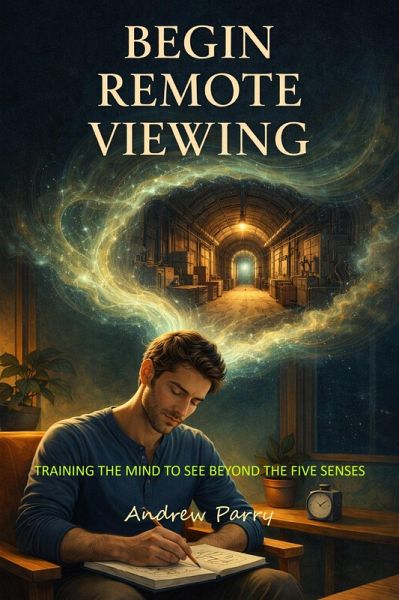
Begin Remote Viewing is a practical, no-drama guide to a craft that's been wrapped in legend and arguments for fifty years-and doesn't need either to work. Instead of selling you fireworks, this book teaches you how to aim attention on purpose, describe what you sense before you name it, keep honest notes, and reveal feedback on time. If you can make small promises and keep them, you can learn remote viewing.
You won't be asked to adopt a belief. You'll be asked to run clean procedures. At the heart of the method is a boring, beautiful sentence: describe an unknown target, while blind to its identity, using adjectives and relationships before nouns, on a clock, and accept feedback. Around that sentence, the book builds a durable practice: breathing that steadies, rituals that keep you honest, scoring that survives scrutiny, archives that don't let memory rewrite history. The result isn't spectacle. It's a curve-slow, modest, reproducible-tilting toward signal.
Inside, you'll find the whole arc of the craft, from foundations to frontier. You'll learn the language of viewing (why "cool, ribbed, vertical" beats "bridge"), the role of state (alpha's soft edges, theta's deeper water), and the skills that protect sessions from your own cleverness (boxing nouns, catching analytical overlay, stopping at the bell). You'll walk through Controlled Remote Viewing (CRV) step by step, explore the longer drift of ERV, and see how Associative Remote Viewing (ARV) turns faint perception into fair, time-bound decisions. You'll learn to build target pools that actually test the channel you train, design decoy sets that keep judges honest, and run double-blind sessions that don't leak.
History and science get their say. You'll meet the pioneers (from Ingo Swann to Joseph McMoneagle) and the researchers who stressed the method in labs. You'll see what held up, what didn't, and why modern replications live or die by boring virtues: pre-registration, real blinding, effect sizes with intervals, multi-site runs. You'll also meet the tools of today: how to let AI be your archivist and methodologist-hashing files, enforcing blinding, building decoys-without ever letting a model impersonate a viewer.
Teachers will find classroom-ready drills and secular framing that administrators can defend; leaders will learn how to build ensembles that harmonize without contaminating; solo practitioners will leave with a daily practice that fits in seven honest minutes. Printable worksheets, step-by-step scripts (including a 10-minute alpha-to-theta induction), clean scoring rubrics, and debrief prompts make the work tangible-and repeatable.
Who is this for? Curious sceptics who prefer tests to slogans. Practitioners tired of theater. Educators who want to teach attention and experimental design without a metaphysics fight. Teams that make decisions under uncertainty and would rather be modest and measurable than loud and wrong. Anyone who suspects their mind can be a better citizen.
If you're looking for a performance, keep scrolling. If you're ready to build a craft, open to page one. Breathe a little longer on the exhale. Write five adjectives about the room you're in. Sketch one relationship between two lines you can see. That's the move. Do it blind to an unknown target with a timer and on-time feedback, and you are already viewing.
You won't be asked to adopt a belief. You'll be asked to run clean procedures. At the heart of the method is a boring, beautiful sentence: describe an unknown target, while blind to its identity, using adjectives and relationships before nouns, on a clock, and accept feedback. Around that sentence, the book builds a durable practice: breathing that steadies, rituals that keep you honest, scoring that survives scrutiny, archives that don't let memory rewrite history. The result isn't spectacle. It's a curve-slow, modest, reproducible-tilting toward signal.
Inside, you'll find the whole arc of the craft, from foundations to frontier. You'll learn the language of viewing (why "cool, ribbed, vertical" beats "bridge"), the role of state (alpha's soft edges, theta's deeper water), and the skills that protect sessions from your own cleverness (boxing nouns, catching analytical overlay, stopping at the bell). You'll walk through Controlled Remote Viewing (CRV) step by step, explore the longer drift of ERV, and see how Associative Remote Viewing (ARV) turns faint perception into fair, time-bound decisions. You'll learn to build target pools that actually test the channel you train, design decoy sets that keep judges honest, and run double-blind sessions that don't leak.
History and science get their say. You'll meet the pioneers (from Ingo Swann to Joseph McMoneagle) and the researchers who stressed the method in labs. You'll see what held up, what didn't, and why modern replications live or die by boring virtues: pre-registration, real blinding, effect sizes with intervals, multi-site runs. You'll also meet the tools of today: how to let AI be your archivist and methodologist-hashing files, enforcing blinding, building decoys-without ever letting a model impersonate a viewer.
Teachers will find classroom-ready drills and secular framing that administrators can defend; leaders will learn how to build ensembles that harmonize without contaminating; solo practitioners will leave with a daily practice that fits in seven honest minutes. Printable worksheets, step-by-step scripts (including a 10-minute alpha-to-theta induction), clean scoring rubrics, and debrief prompts make the work tangible-and repeatable.
Who is this for? Curious sceptics who prefer tests to slogans. Practitioners tired of theater. Educators who want to teach attention and experimental design without a metaphysics fight. Teams that make decisions under uncertainty and would rather be modest and measurable than loud and wrong. Anyone who suspects their mind can be a better citizen.
If you're looking for a performance, keep scrolling. If you're ready to build a craft, open to page one. Breathe a little longer on the exhale. Write five adjectives about the room you're in. Sketch one relationship between two lines you can see. That's the move. Do it blind to an unknown target with a timer and on-time feedback, and you are already viewing.
Dieser Download kann aus rechtlichen Gründen nur mit Rechnungsadresse in A, B, CY, CZ, D, DK, EW, E, FIN, F, GR, H, IRL, I, LT, L, LR, M, NL, PL, P, R, S, SLO, SK ausgeliefert werden.
Andere Kunden interessierten sich für