Ancient Philosophies Explained: From Stoicism to Vedanta-Lessons for Modern Life (eBook, ePUB)

PAYBACK Punkte
0 °P sammeln!

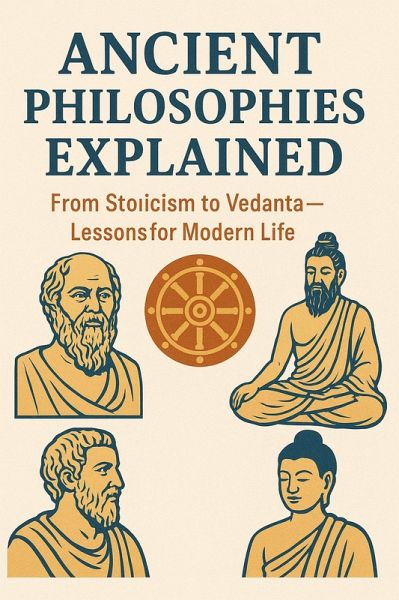
Ancient Philosophies Explained: From Stoicism to Vedanta-Lessons for Modern Life is a wide-ranging, accessible exploration of how the world's great wisdom traditions can illuminate contemporary existence. Moving from the colonnades of ancient Athens to the forests of India, from Confucian courts to Persian fire-temples, the book treats philosophy not as abstract theory but as a lived art: a disciplined way of seeing, choosing, and relating that can steady a person amid anxiety, distraction, and rapid change.The early chapters introduce Greco-Roman schools such as Stoicism, Epicureanism, Cynici...
Ancient Philosophies Explained: From Stoicism to Vedanta-Lessons for Modern Life is a wide-ranging, accessible exploration of how the world's great wisdom traditions can illuminate contemporary existence. Moving from the colonnades of ancient Athens to the forests of India, from Confucian courts to Persian fire-temples, the book treats philosophy not as abstract theory but as a lived art: a disciplined way of seeing, choosing, and relating that can steady a person amid anxiety, distraction, and rapid change.
The early chapters introduce Greco-Roman schools such as Stoicism, Epicureanism, Cynicism, and Skepticism, showing how they grappled with fear, desire, and the search for inner freedom. Readers encounter Stoic emotional discipline and the four cardinal virtues, Epicurean simplicity and friendship, and the radical honesty of the Cynics, each translated into concrete guidance for work, relationships, and modern consumer culture. The focus then shifts eastward to Confucianism and Daoism, Buddhism in its Theravada and Mahayana forms, and the rich spectrum of Indian thought-from Yoga and Saṃkhya to the many strands of Vedanta, alongside the uncompromising nonviolence of Jainism.
Rather than isolating traditions, the book continually draws connections: between Stoic and Buddhist attitudes to suffering, between Daoist "effortless action" and modern burnout, between Vedantic non-duality and contemporary debates about consciousness, between Jain many-sidedness and our polarized public square. Later chapters widen the lens to ethics, politics, and death, asking what these philosophies imply about justice "from polis to planet," the art of dying, and the nature of self and ego. The final chapters translate high ideas into daily practices-morning and evening routines, habits of speech, consumption, technology use, and relationship-that allow readers to build a personal "philosophical practice plan."
Without asking anyone to adopt a new label or convert to a single school, Ancient Philosophies Explained invites readers to craft a coherent, humane way of life from the best insights of multiple traditions. It is a book for those who sense that information is not enough, and who are ready to mine the world's oldest questions for guidance on how to live with greater clarity, courage, compassion, and depth today.
The early chapters introduce Greco-Roman schools such as Stoicism, Epicureanism, Cynicism, and Skepticism, showing how they grappled with fear, desire, and the search for inner freedom. Readers encounter Stoic emotional discipline and the four cardinal virtues, Epicurean simplicity and friendship, and the radical honesty of the Cynics, each translated into concrete guidance for work, relationships, and modern consumer culture. The focus then shifts eastward to Confucianism and Daoism, Buddhism in its Theravada and Mahayana forms, and the rich spectrum of Indian thought-from Yoga and Saṃkhya to the many strands of Vedanta, alongside the uncompromising nonviolence of Jainism.
Rather than isolating traditions, the book continually draws connections: between Stoic and Buddhist attitudes to suffering, between Daoist "effortless action" and modern burnout, between Vedantic non-duality and contemporary debates about consciousness, between Jain many-sidedness and our polarized public square. Later chapters widen the lens to ethics, politics, and death, asking what these philosophies imply about justice "from polis to planet," the art of dying, and the nature of self and ego. The final chapters translate high ideas into daily practices-morning and evening routines, habits of speech, consumption, technology use, and relationship-that allow readers to build a personal "philosophical practice plan."
Without asking anyone to adopt a new label or convert to a single school, Ancient Philosophies Explained invites readers to craft a coherent, humane way of life from the best insights of multiple traditions. It is a book for those who sense that information is not enough, and who are ready to mine the world's oldest questions for guidance on how to live with greater clarity, courage, compassion, and depth today.
Dieser Download kann aus rechtlichen Gründen nur mit Rechnungsadresse in A, B, CY, CZ, D, DK, EW, E, FIN, F, GR, H, IRL, I, LT, L, LR, M, NL, PL, P, R, S, SLO, SK ausgeliefert werden.
Andere Kunden interessierten sich für