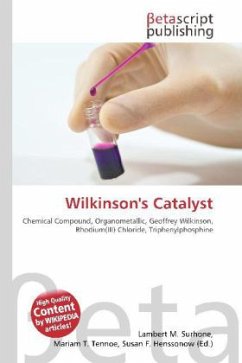
Wilkinson's Catalyst
Versandkostenfrei!
Versandfertig in 6-10 Tagen
19,99 €
inkl. MwSt.

PAYBACK Punkte
10 °P sammeln!

Please note that the content of this book primarily consists of articles available from Wikipedia or other free sources online. Wilkinson''s catalyst is the common name for chlorotris(triphenylphosphine)rhodium(I), a chemical compound with the formula RhCl(PPh3)3 (Ph = phenyl). It is named after the late organometallic chemist and 1973 Nobel Laureate, Sir Geoffrey Wilkinson who popularized its use. The compound is a square planar, 16-electron complex and is usually isolated in the form of a red-violet crystalline solid from the reaction of rhodium(III) chloride with excess triphenylphosphine. ...
Please note that the content of this book primarily consists of articles available from Wikipedia or other free sources online. Wilkinson''s catalyst is the common name for chlorotris(triphenylphosphine)rhodium(I), a chemical compound with the formula RhCl(PPh3)3 (Ph = phenyl). It is named after the late organometallic chemist and 1973 Nobel Laureate, Sir Geoffrey Wilkinson who popularized its use. The compound is a square planar, 16-electron complex and is usually isolated in the form of a red-violet crystalline solid from the reaction of rhodium(III) chloride with excess triphenylphosphine. The synthesis is conducted in refluxing ethanol. Triphenylphosphine serves as the reducing agent yielding triphenylphosphine oxide. Wilkinson''s catalyst catalyzes the hydrogenation of alkenes, the mechanism of which involves the initial dissociation of one or two triphenylphosphine ligands to give 14 or 12-electron complexes, respectively, followed by oxidative addition of H2 to the metal.
Andere Kunden interessierten sich für