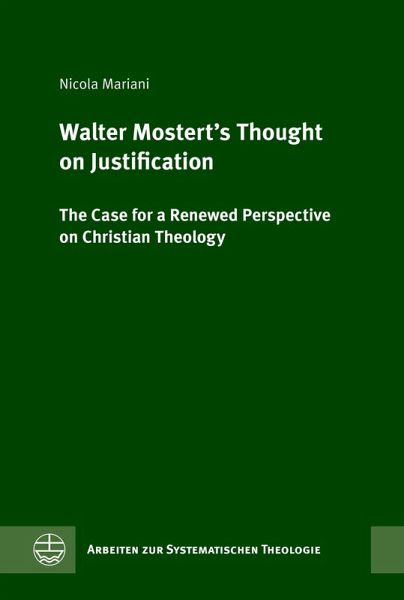
Walter Mostert's Thought on Justification
The Case for a Renewed Perspective on Christian Theology
Versandkostenfrei!
Erscheint vorauss. 30. Januar 2026
148,00 €
inkl. MwSt.

The study analyzes four macro-areas of Walter Mostert's theology of justification in dialogue with alternative approaches as a source of relevant theological insights. Mostert avoids both subjectivism and objectivism, understanding theology as the soteriological answer to sin as the usurpation of God's salvific prerogative. Justification is God's saving act, received in faith as one's being-in-Christ. It establishes an anthropology in which the human being is defined not by personal deeds but by the gifted Gospel. Justification is thus distinct from ideological thinking and its theory-praxis m...
The study analyzes four macro-areas of Walter Mostert's theology of justification in dialogue with alternative approaches as a source of relevant theological insights. Mostert avoids both subjectivism and objectivism, understanding theology as the soteriological answer to sin as the usurpation of God's salvific prerogative. Justification is God's saving act, received in faith as one's being-in-Christ. It establishes an anthropology in which the human being is defined not by personal deeds but by the gifted Gospel. Justification is thus distinct from ideological thinking and its theory-praxis model. It founds the Church and serves as the basis for ecumenical consensus. Despite certain one-sided aspects, Mostert's theology allows for a clear articulation of the Gospel. [Walter Mosterts Gedanken zur Rechtfertigung. Argumente für eine neue Perspektive in der christlichen Theologie] Die Studie analysiert vier Makrobereiche von Walter Mosterts Rechtfertigungstheologie im Dialog mit alternativen Ansätzen als Quelle aktueller theologischer Impulse. Mostert meidet Subjektivismus und Objektivismus und versteht Theologie als die soteriologische Antwort auf die Sünde als Anmaßung des göttlichen Heilsprärogativs. Rechtfertigung ist Gottes Heilshandeln, das im Glauben als Sein-in-Christus empfangen wird. Sie begründet eine Anthropologie, in der der Mensch durch das geschenkte Evangelium, nicht durch das eigene Tun bestimmt ist. Rechtfertigung unterscheidet sich daher vom Theorie-Praxis-Modell ideologischen Denkens. Sie gründet die Kirche und ist die Basis für ökumenischen Konsens. Trotz aller Einseitigkeit ermöglicht Mosterts Theologie eine klare Profilierung des Evangeliums.