VLSI for IoT and M2M
Versandkostenfrei!
Versandfertig in 6-10 Tagen
29,99 €
inkl. MwSt.

PAYBACK Punkte
15 °P sammeln!

VLSI (Very Large Scale Integration) technology plays a crucial role in advancing IoT (Internet of Things) and M2M (Machine-to-Machine) systems by enabling the design of compact, low-power, and high-performance hardware. Through the integration of processing cores, memory, sensors, and communication modules into a single chip-such as a System-on-Chip (SoC) or System-in-Package (SiP)-VLSI supports the development of intelligent edge devices capable of real-time data processing and secure communication. It enables support for diverse communication protocols like NB-IoT, LoRa, ZigBee, Wi-Fi, and B...
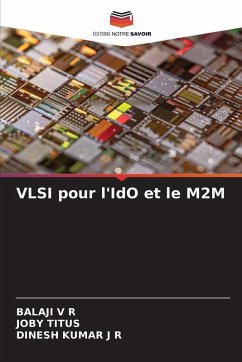
VLSI (Very Large Scale Integration) technology plays a crucial role in advancing IoT (Internet of Things) and M2M (Machine-to-Machine) systems by enabling the design of compact, low-power, and high-performance hardware. Through the integration of processing cores, memory, sensors, and communication modules into a single chip-such as a System-on-Chip (SoC) or System-in-Package (SiP)-VLSI supports the development of intelligent edge devices capable of real-time data processing and secure communication. It enables support for diverse communication protocols like NB-IoT, LoRa, ZigBee, Wi-Fi, and BLE while incorporating hardware-level security features such as encryption engines and secure key storage. Reconfigurable architectures, like FPGAs, further add flexibility for protocol adaptation and post-deployment updates. VLSI also supports AI acceleration at the edge, enabling predictive maintenance and autonomous operation in M2M systems. As a result, VLSI stands as a foundational technology for the evolution of scalable, reliable, and intelligent IoT and M2M applications across various industries, including smart cities, healthcare, agriculture, and industrial automation.
Andere Kunden interessierten sich für