Virology
Versandkostenfrei!
Versandfertig in 6-10 Tagen
23,99 €
inkl. MwSt.

PAYBACK Punkte
12 °P sammeln!

Please note that the content of this book primarily consists of articles available from Wikipedia or other free sources online.Virology is the study of viruses and virus-like agents: their structure, classification and evolution, their ways to infect and exploit cells for virus reproduction, the diseases they cause, the techniques to isolate and culture them, and their use in research and therapy. Virology is often considered a part of microbiology or of pathology. A major branch of virology is virus classification. Viruses can be classified according to the host cell they infect: animal virus...
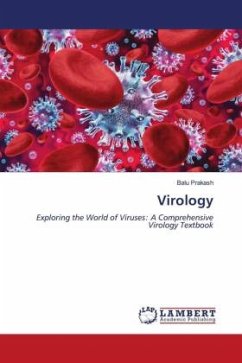
Please note that the content of this book primarily consists of articles available from Wikipedia or other free sources online.Virology is the study of viruses and virus-like agents: their structure, classification and evolution, their ways to infect and exploit cells for virus reproduction, the diseases they cause, the techniques to isolate and culture them, and their use in research and therapy. Virology is often considered a part of microbiology or of pathology. A major branch of virology is virus classification. Viruses can be classified according to the host cell they infect: animal viruses, plant viruses, fungal viruses, and bacteriophages (viruses infecting bacteria, which include the most complex viruses). Another classification uses the geometrical shape of their capsid (often a helix or an icosahedron) or the virus''s structure (e.g. presence or absence of a lipid envelope). Viruses range in size from about 30 nm to about 450 nm, which means that most of them cannot be seen with light microscopes. The shape and structure of viruses can be studied with electron microscopy, with NMR spectroscopy, and most importantly with X-ray crystallography.