Gutscheinbedingungen

**Gültig bis 10.06.2026 / Gültig für gebrauchte Bücher / Mindestbestellwert 20,00 € / Einzelne Artikel können ausgeschlossen sein / Online auf www.bücher.de.de / Nicht kombinierbar mit anderen Gutscheinen oder Preisaktionen / Nur einmal pro Einkauf einlösbar / Gutschein wird auf max. 500€ Bestellwert angerechnet / Keine Barauszahlung / Nicht gültig für Versandkosten und Services

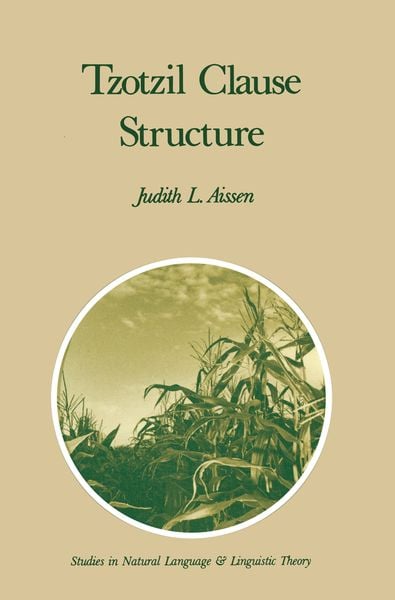
  • Produktbild: Tzotzil Clause Structure
  • Produktbild: Tzotzil Clause Structure
Band 7 - 12%

Tzotzil Clause Structure

12% sparen

139,99 € UVP 160,49 €

inkl. gesetzl. MwSt., Versandkostenfrei

Lieferung nach Hause

Beschreibung

Produktdetails

Einband

Gebundene Ausgabe

Erscheinungsdatum

31.03.1987

Verlag

Springer Netherland

Seitenzahl

320

Maße (L/B/H)

24,1/16/2,2 cm

Gewicht

643 g

Auflage

1987

Sprache

Englisch

ISBN

978-90-277-2365-9

Beschreibung

Produktdetails

Einband

Gebundene Ausgabe

Erscheinungsdatum

31.03.1987

Verlag

Springer Netherland

Seitenzahl

320

Maße (L/B/H)

24,1/16/2,2 cm

Gewicht

643 g

Auflage

1987

Sprache

Englisch

ISBN

978-90-277-2365-9

Herstelleradresse


Kundinnen und Kunden meinen

0 Bewertungen

Informationen zu Bewertungen

Zur Abgabe einer Bewertung ist eine Anmeldung im Konto notwendig. Die Authentizität der Bewertungen wird von uns nicht überprüft. Wir behalten uns vor, Bewertungstexte, die unseren Richtlinien widersprechen, entsprechend zu kürzen oder zu löschen.

Die Bewertungen sind nach Format, Anzahl Sterne und Datum sortiert.

Verfassen Sie die erste Bewertung zu diesem Artikel

Helfen Sie anderen Kund*innen durch Ihre Meinung

Kundinnen und Kunden meinen

0 Bewertungen filtern

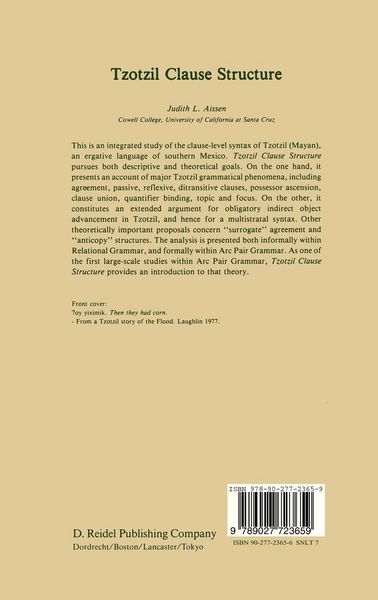
  • Produktbild: Tzotzil Clause Structure
  • Produktbild: Tzotzil Clause Structure
  • 1: Grammatical Notes.- 1. Introduction.- 2. Basics.- 3. Major Lexical Classes.- 3.1. V.- 3.2. N.- 3.3. A.- 3.3.1. Quantifiers.- 3.3.2. Existentials and Locatives.- 4. Minor Lexical Classes.- 4.1. Clitics.- 4.1.1. Clause-proclitic.- 4.1.2. S-enclitic.- 4.1.3. V-enclitic.- 4.1.4. Clause-second.- 4.2. Directionals.- 4.3. Particles.- 5. Flagging.- 6. Word Order.- 7. Construction Survey.- 7.1. Negation.- 7.2. Questions.- 7.3. Complement Clauses.- 7.4. Motion cum Purpose.- 7.5. Topics.- 7.6. Prepredicate Position.- Notes.- 2: Theoretical Sketch.- 1. Arcs.- 1.1. Sets of Grammatical Relations.- 1.2. Stratum.- 1.3. Ergative and Absolutive.- 1.4. Formal Connections between Arcs.- 2. Sponsor and Erase.- 2.1. Successors.- 2.2. Replacers.- 2.3. Self-Sponsor and Self-Erase.- 3. Ancestral Relations.- 4. Pair Networks.- 5. Resolution of Overlapping Arcs.- 6. Coordinate Determination.- 7. Rules and Laws.- 8. Word Order.- 9. APG Versions of RG Laws.- 9.1. Stratal Uniqueness Law.- 9.2. Chomeur Law and Motivated Chomage Law.- 9.3. Relational Succession Law and Host Limitation Law.- 9.4. Final 1 Law.- Notes.- 3: Inflection and Agreement.- 1. Introduction.- 2. Moods and Aspects.- 2.1. Neutral Aspect.- 2.2. Incompletive Aspect.- 2.3. Completive Aspect.- 2.4. Perfect Aspect.- 3. Cross-referencing Person.- 3.1. Set A Affixes.- 3.2. Set B Affixes.- 3.3. Imperative Suffixes.- 4. Cross-referencing Number.- 4.1. First Person.- 4.2. Second and Third Person.- 5. The Optionality of Number Agreement.- 6. Agreement and Covert Arguments.- 7. APG Account of Agreement.- 7.1. Agreement Laws.- 7.2. Tzotzil Agreement Rules.- Notes.- 4: Passive Clauses.- 1. Introduction.- 2. Syntax of Passive Clauses.- 2.1. Advancement to Subject.- 2.2. Passive Suffixes.- 2.2.1. -e: Monosyllabic Stems.- 2.2.2. -bil: Passive Perfects.- 3. Tzotzil Passive Rules (APG).- 3.1. Passive Chomeurs.- 3.2. The Form of Chomeurs.- 3.2.1. Possessor of Relational Noun.- 3.2.2. Object of Preposition.- 3.2.3. Passive Chomeur Rule.- 3.3. Passive Suffixes.- 3.4. Other Passive Rules.- Notes.- 5: Reflexive Clauses.- 1. Introduction.- 2. Reflexive Clauses.- 3. Reciprocal Coreference.- 4. Tzotzil Rules (APG).- 4.1. Lower Pioneer.- 4.2. Conditions on Reflexives.- Notes.- 6: Unaccusative Clauses.- 1. Introduction.- 2. Reflexive Unaccusative Clauses.- 3. Plain Unaccusative Clauses.- 3.1. Bivalent Stems.- 3.2. Morphological Properties of Bivalent Stems.- 3.2.1. Perfect.- 3.2.2. Subjunctive.- 4. Verb Classification.- 5. Tzotzil Rules (APG).- Notes.- 7: Ditransitive Clauses.- 1. Introduction.- 2. Ditransitive Clauses.- 3. 3-to-2 Advancement.- 3.1. Agreement.- 3.2. Ditransitive Passives.- 3.3. Ditransitive Reflexives.- 4. Non-Existence of Final Indirect Objects.- 5. Restrictions on Advancement.- 5.1. Chomage Condition.- 5.2. Person Restriction.- 6. Ditransitive Perfect Passives.- 7. Tzotzil Rules (APG).- 7.1. 3-to-2 Advancement.- 7.2. Ditransitive Passives.- 7.3. Ditransitive Reflexives.- 8. Conclusion.- Notes.- 8: Possessor Ascension.- 1. Introduction.- 2. Possessor Ascension.- 2.1. Agreement.- 2.2. Passive.- 2.3. Reflexives.- 3. Coreference Condition 1.- 4. Restriction on Ascension Host.- 5. Tzotzil Possessor Ascension Rule.- 6. The Unique 3 Arc Constraint.- 7. Optional Cases of Possessor Ascension.- 7.1. First and Second Person Possessors.- 7.2. Non-Pronominal Possessors.- 8. Coreference Condition 2.- 9. Possessor Ascension in Discourse.- 10. APG Laws and Tzotzil Rules.- 10.1. Possessor Ascension.- 10.2. Other Rules.- 11. Conclusion.- Notes.- 9: Topic, Focus, and Copy Possessor Ascension.- 1. Introduction.- 2. Distinguishing Topic and Focus.- 3. Surface Constituency in Possessor Ascension Structures.- 3.1. Evidence from other Extraction Structures.- 3.2. Other Resolutions of Possessor Ascension.- 4. Topic and Focus.- 4.1. Topicalization.- 4.2. Focus.- 5. Copy and Coreferential Pronouns.- 6. APG Laws and Tzotzil Rules.- 6.1. Possessor Ascension and the Successor Erase Law.- 6.2. Surface Constituency in Possessor Ascension Structures.- 6.3. Coreference Rule.- 6.4. Topic and Focus.- 6.4.1. Overlay Relations.- 6.4.2. Tzotzil Constraints.- 6.5. Conclusion.- Notes.- 10: Surrogate Agreement.- 1. Introduction.- 2. Possessor Ascension.- 3. Conjunct Union.- 3.1. -chi7uk.- 3.1.1. xchi7uk as Conjunction.- 3.1.2. -chi7uk as Predicate.- 3.1.3. xchi7uk as Flag.- 3.2. Conjunct Union.- 3.3. Reflexive Conjunct Union.- 3.4. Indefinite Comitatives.- 4. Summary.- 5. APG Laws and Tzotzil Rules.- 5.1. Conjunct Union.- 5.2. Conjunct Union Law.- 5.3. Tzotzil Conjunct Union Rules.- 5.4. Reflexive Conjunct Union.- 5.5. Surrogate Agreement.- 6. Conclusion.- Notes.- 11: Clause Unions.- 1. Introduction.- 2. Causative Clause Union.- 2.1. Evidence for Initial Biclausal Structure.- 2.2. Evidence for Union: Complement Subject.- 2.2.1. Interaction with Passive.- 2.2.2. Interaction with Possessor Ascension.- 2.3. Evidence for Union: Complement Direct Object.- 2.3.1. Chomeur Restriction.- 2.3.2. Reflexive Restriction.- 2.4. Advancements in the Complement.- 2.5. Conclusion.- 3. Abilitative Clause Union.- 3.1. Analysis.- 3.2. Unaccusative Complement.- 3.3. Initial Biclausal Structure.- 3.4. Final Monoclausal Structure.- 3.5. Further Remarks on Inflection.- 3.6. Interaction with Possessor Ascension.- 4. Summary.- 5. APG Laws and Tzotzil Rules.- Notes.- 12: Quantification and Initial Absolutives.- 1. Introduction.- 2. Quantifiers.- 3. Prepredicate Quantifiers without Classifier.- 3.1. Monotransitive Clauses.- 3.2. Ditransitive Clauses.- 3.3. Reflexive Clauses.- 4. Prepredicate Quantifiers with Classifier.- 5. Postpredicate Quantifiers.- 6. Grammatical Relations versus Linear Order.- 6.1. Binding Ergatives in Reflexive Clauses.- 6.2. Pima Quantifier Binding.- 7. Conclusion.- Notes.- Conclusion.- Phonological Rules.- 1. Deletion of Stem-initial Glottal Stop.- 2. Deletion of Prevocalic A3 Prefix.- 3. Neutral Aspect Marker.- 4. Spirant Assimilation.- 5. Contraction.- 6. Geminate Reduction.- 7. Vowel Deletion.- 7.1. Transitive Imperative.- 7.2. -be.- References.