

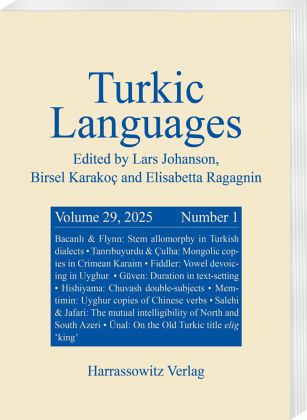
Turkic Languages 29 (2025) 1
Versandkostenfrei!
Versandfertig in 6-10 Tagen
64,00 €
inkl. MwSt.

PAYBACK Punkte
0 °P sammeln!

The journal Turkic Languages is devoted to linguistic Turcology. It addresses descriptive, comparative, synchronic, diachronic, theoretical, and methodological problems of the study of Turkic languages including questions of genetic, typological and areal relations, linguistic variation, and language acquisition. The journal aims at presenting work of current interest on a variety of subjects, and thus welcomes contributions on all aspects of Turkic language studies. It contains articles, review articles, reviews, discussions, reports, and surveys of publications.The journal uses a double blin...
The journal Turkic Languages is devoted to linguistic Turcology. It addresses descriptive, comparative, synchronic, diachronic, theoretical, and methodological problems of the study of Turkic languages including questions of genetic, typological and areal relations, linguistic variation, and language acquisition. The journal aims at presenting work of current interest on a variety of subjects, and thus welcomes contributions on all aspects of Turkic language studies. It contains articles, review articles, reviews, discussions, reports, and surveys of publications.The journal uses a double blind review system in selecting articles for publication. The preferred language of publication is English.From the contents (altogether 9 contributions):Eyüp Bacanli & Darin Flynn, Stem allomorphy in Southwestern Turkish dialectsGülçin Tanribuyurdu & Tülay Çulha, Mongolic copies in Crimean KaraimMichael Fiddler, Vowel devoicing in Uyghur: Phonetics and phonologyMine Güven, Aspects of duration in textsetting: A segmental analysis of two Turkish versions of Franz Schubert's Ellens Gesang III (D. 839)Yuto Hishiyama, Double-subject constructions in ChuvashAminem Memtimin, Copying Chinese verbs into UyghurMohammad Salehi & Rasoul Jafari, Two countries, two dialects. Testing the mutual intelligibility of North and South AzeriOrçun Ünal, On the origin of the Old Turkic title elig 'king'