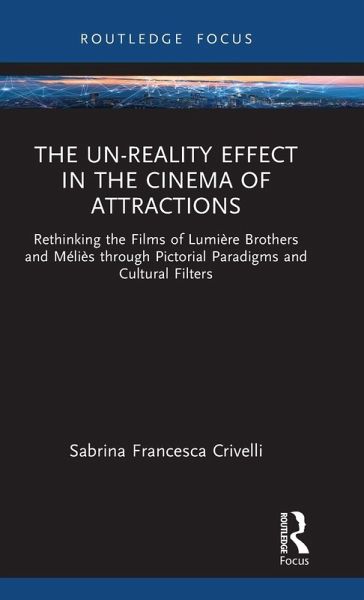
The Un-Reality Effect in the Cinema of Attractions
Rethinking the Films of Lumiere brothers and Melies through Pictorial Paradigms and Cultural Filters
Versandkostenfrei!
Versandfertig in über 4 Wochen
60,99 €
inkl. MwSt.
Weitere Ausgaben:

PAYBACK Punkte
30 °P sammeln!

The Un-Reality Effect in the Cinema of Attractions offers an original rethinking of early European cinema through the lens of its visual and cultural entanglements. Focusing on the works of the Lumière brothers and Georges Méliès, this book situates their films within the cinema of attractions, revealing how pictorial paradigms and cultural filters shaped both realist and fantastical modes of representation, ultimately producing what is here defined as the un-reality effect. Offering an original contribution to the study of cinema-painting intermediality, the author relates the analysis of ...
The Un-Reality Effect in the Cinema of Attractions offers an original rethinking of early European cinema through the lens of its visual and cultural entanglements. Focusing on the works of the Lumière brothers and Georges Méliès, this book situates their films within the cinema of attractions, revealing how pictorial paradigms and cultural filters shaped both realist and fantastical modes of representation, ultimately producing what is here defined as the un-reality effect. Offering an original contribution to the study of cinema-painting intermediality, the author relates the analysis of its aesthetical and cultural implications to the understanding of its impact on the filmic configuration. This book investigates how visual sources could be seen as abstracting factors and how visual and cultural references function as an anti-realist device, suggesting the notion of 'un-realities' as a conceptual category that accounts for a film's propensity to overcome the physical reality with artificial, culturally charged, cinematic worlds. Engaging critically with foundational theories by Gunning and Gaudreault, and drawing on art history, visual culture, and intermedial studies, this volume bridges cinema and the visual arts in new ways. Written in an accessible style and complemented by a visual appendix, it speaks to scholars and students across film history, theory, visual culture, and interdisciplinary cultural studies. By revisiting the intersections between realism and illusionism, it opens fresh pathways for future research on cinema's intermedial foundations.
Andere Kunden interessierten sich für