Gutscheinbedingungen

**Gültig bis 10.06.2026 / Gültig für gebrauchte Bücher / Mindestbestellwert 20,00 € / Einzelne Artikel können ausgeschlossen sein / Online auf www.bücher.de.de / Nicht kombinierbar mit anderen Gutscheinen oder Preisaktionen / Nur einmal pro Einkauf einlösbar / Gutschein wird auf max. 500€ Bestellwert angerechnet / Keine Barauszahlung / Nicht gültig für Versandkosten und Services

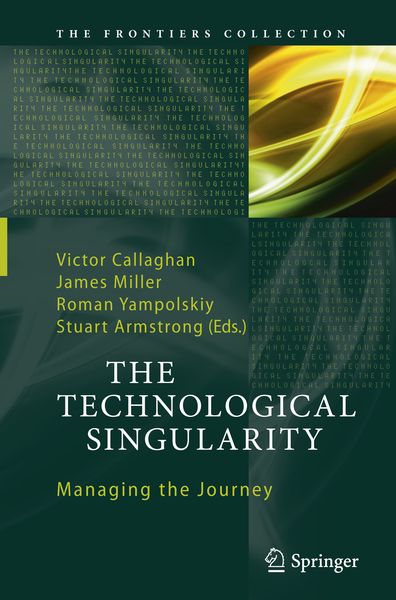
Produktbild: The Technological Singularity

The Technological Singularity Managing the Journey

Aus der Reihe The Frontiers Collection

73,99 €

inkl. gesetzl. MwSt., Versandkostenfrei

Lieferung nach Hause

Beschreibung

Produktdetails

Einband

Taschenbuch

Erscheinungsdatum

09.05.2018

Abbildungen

XII, 11 illus., 8 illus. in color., farbige Illustrationen, schwarz-weiss Illustrationen

Herausgeber

Victor Callaghan + weitere

Verlag

Springer Berlin

Seitenzahl

261

Maße (L/B/H)

23,5/15,5/1,6 cm

Gewicht

423 g

Auflage

Softcover reprint of the original 1st edition 2017

Sprache

Englisch

ISBN

978-3-662-57174-3

Beschreibung

Rezension

“There is a wealth of information here, including hundreds of references to recent research. The editors have done a fine job of collecting and presenting all sides of the AGI issue. The papers are well written, and are all relevant … . this book should be of interest to anyone wishing to learn about the technological singularity and its implications.” (G. R. Mayforth, Computing Reviews, May, 2018)

Portrait

Victor Callaghan is Professor of Computer Science at the University of Essex where he founded the Robotics and Intelligent Environments research groups, publishing over 300 related articles. He is president of the Association for the Advancement of Intelligent Environments, director the Creative Science Foundation and a founding board member of Sapience, organizations which all study the impact of artificial intelligence on our futures.

James D. Miller is Associate Professor of Economics at Smith College.  He has a Ph.D. in Economics from the University of Chicago and a law degree from Stanford.  The author of the books Singularity Rising and Game Theory at Work,  he is interested in how increases in human and artificial intelligences will influence the economy.

Roman V. Yampolskiy is a Tenured Associate Professor in the department of Computer Engineering and Computer Science at the University of Louisville. He is the founding and current director of the Cyber Security Lab and an author of many books including Artificial Superintelligence: a Futuristic Approach. Dr. Yampolskiy’s main areas of interest are Artificial Intelligence Safety and Cybersecurity

Stuart Armstrong is, an Alexander Tamas research fellow at the Future of Humanity Institute, works on formal decision theory, general existential risk, the risks and possibilities of Artificial Intelligence (AI), how AIs can learn humane values, assessing expertise and predictions, and anthropic (self-locating) probability. His booklet “Smarter than Us: the rise of machine intelligence” lays out some the challenges in this area.


Produktdetails

Einband

Taschenbuch

Erscheinungsdatum

09.05.2018

Abbildungen

XII, 11 illus., 8 illus. in color., farbige Illustrationen, schwarz-weiss Illustrationen

Herausgeber

Verlag

Springer Berlin

Seitenzahl

261

Maße (L/B/H)

23,5/15,5/1,6 cm

Gewicht

423 g

Auflage

Softcover reprint of the original 1st edition 2017

Sprache

Englisch

ISBN

978-3-662-57174-3

Herstelleradresse

Springer-Verlag KG
Sachsenplatz 4-6
1201 Wien
AT

Email: ProductSafety@springernature.com

Kundinnen und Kunden meinen

0 Bewertungen

Informationen zu Bewertungen

Zur Abgabe einer Bewertung ist eine Anmeldung im Konto notwendig. Die Authentizität der Bewertungen wird von uns nicht überprüft. Wir behalten uns vor, Bewertungstexte, die unseren Richtlinien widersprechen, entsprechend zu kürzen oder zu löschen.

Die Bewertungen sind nach Format, Anzahl Sterne und Datum sortiert.

Verfassen Sie die erste Bewertung zu diesem Artikel

Helfen Sie anderen Kund*innen durch Ihre Meinung

Kundinnen und Kunden meinen

0 Bewertungen filtern

  • Produktbild: The Technological Singularity
  • Introduction (Stuart Armstrong).- PART 1: RISKS OF, AND RESPONSES TO, THE JOURNEY TO THE SINGULARITY.- The Risks (Roman Yampolskiy & Kaj Sotala).- The Responses (Roman Yampolskiy & Kaj Sotala).- PART 2: MANAGING THE SINGULARITY JOURNEY.- How Change Agencies Affect Our Path Towards a Possible Singularity (Ping Zheng, Mohammed Asif Akhmad).- Agent Foundations for Aligning Machine Intelligence with Human Interests: A Technical Research Agenda (Nate Soares and Benya Fallenstein).- Risk Analysis and Risk Management for the Artificial General Intelligence Research and Development Process (Anthony Barrett, Seth Baum).- Diminishing Returns and Recursive Self Improving AI (Roman Yampolskiy, Andrew Majot).- Energy, Complexity, and the Singularity (Kent Peacock).- Computer simulations as a technological singularity in the empirical sciences (Juan Duran).- Can the Singularity be Patented (David Koepsell).- The Emotional Nature of Postcognitive Singularities (Jordi Vallverdu).- A Psychoanalytical Approach to the Singularity: Why We Cannot Do Without Auxiliary Constructions (Graham Clarke).- PART 3: REFLECTIONS ON THE JOURNEY.- Reflections on Vinge's Singularity Vision (James Miller).-  Singularity Blog Insights (James Miller, Eliezer Yudkowsky, Stuart Armstrong, Scott Siskind, Scott Aaronson.- Appendix: The Coming Technological Singularity: How to Survive in the Post-Human Era (Vernor Vinge).