

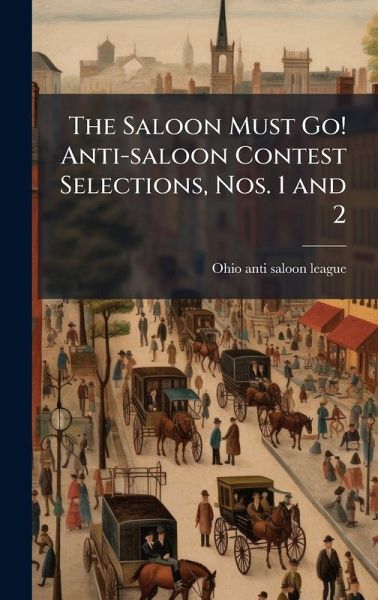
The Saloon Must Go! Anti-saloon Contest Selections, Nos. 1 and 2
Versandkostenfrei!
Versandfertig in über 4 Wochen
31,99 €
inkl. MwSt.

PAYBACK Punkte
16 °P sammeln!

The Saloon Must Go! Anti-saloon Contest Selections, Nos. 1 and 2 presents a snapshot of the late 19th-century temperance movement in Ohio and beyond. Published by the Ohio Anti-Saloon League, this volume compiles persuasive essays and arguments against the pervasive influence of saloons. The selections offer insight into the social, moral, and political concerns driving the push for prohibition. These documents showcase the strategies and rhetoric employed by reformers seeking to eliminate what they viewed as a destructive societal ill. They highlight the organization's activities and the wide...
The Saloon Must Go! Anti-saloon Contest Selections, Nos. 1 and 2 presents a snapshot of the late 19th-century temperance movement in Ohio and beyond. Published by the Ohio Anti-Saloon League, this volume compiles persuasive essays and arguments against the pervasive influence of saloons. The selections offer insight into the social, moral, and political concerns driving the push for prohibition. These documents showcase the strategies and rhetoric employed by reformers seeking to eliminate what they viewed as a destructive societal ill. They highlight the organization's activities and the wider cultural debates around alcohol consumption, public order, and social responsibility. This work provides valuable primary source material for researchers and anyone interested in the history of American social reform, prohibition, and the temperance movement. This work has been selected by scholars as being culturally important, and is part of the knowledge base of civilization as we know it. This work was reproduced from the original artifact, and remains as true to the original work as possible. Therefore, you will see the original copyright references, library stamps (as most of these works have been housed in our most important libraries around the world), and other notations in the work. This work is in the public domain in the United States of America, and possibly other nations. Within the United States, you may freely copy and distribute this work, as no entity (individual or corporate) has a copyright on the body of the work. As a reproduction of a historical artifact, this work may contain missing or blurred pages, poor pictures, errant marks, etc. Scholars believe, and we concur, that this work is important enough to be preserved, reproduced, and made generally available to the public. We appreciate your support of the preservation process, and thank you for being an important part of keeping this knowledge alive and relevant.