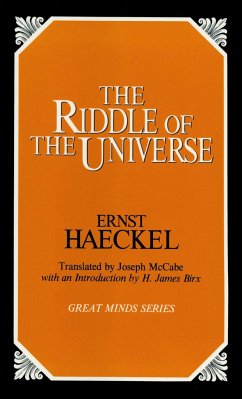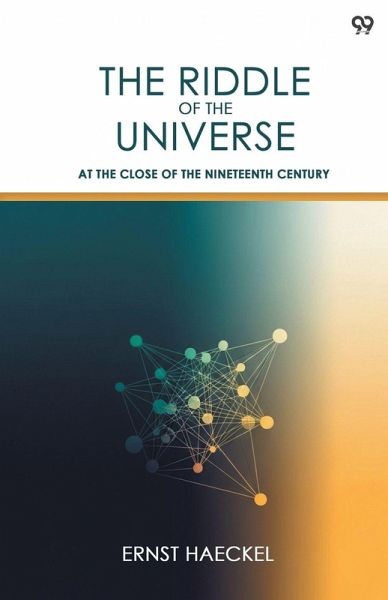
The Riddle Of The Universe At The Close Of The Nineteenth Century
Versandkostenfrei!
Versandfertig in 1-2 Wochen
17,99 €
inkl. MwSt.
Weitere Ausgaben:

PAYBACK Punkte
9 °P sammeln!

The riddle of the universe at the close of the nineteenth century examines the evolving relationship between scientific inquiry and philosophical thought. It highlights the rise of empirical understanding in fields like biology and cosmology while pointing to a contrasting stagnation in moral and spiritual perspectives. Drawing on natural laws, evolutionary processes, and material structures, it argues for a unified explanation of existence rooted in observable phenomena. The work introduces the idea of world riddles deep questions about life, mind, and the cosmos that challenge fragmented or ...
The riddle of the universe at the close of the nineteenth century examines the evolving relationship between scientific inquiry and philosophical thought. It highlights the rise of empirical understanding in fields like biology and cosmology while pointing to a contrasting stagnation in moral and spiritual perspectives. Drawing on natural laws, evolutionary processes, and material structures, it argues for a unified explanation of existence rooted in observable phenomena. The work introduces the idea of world riddles deep questions about life, mind, and the cosmos that challenge fragmented or mystical interpretations of reality. It promotes a monistic framework that sees all physical and mental forms as expressions of a singular substance, eliminating dualistic divisions between body and spirit. This approach combines scientific reasoning with existential curiosity, encouraging reflection on the continuity of nature and human consciousness within it. Rather than isolate disciplines, it advocates for an integrated view of knowledge that reshapes how existence, identity, and purpose are understood at a pivotal point in intellectual history.
Andere Kunden interessierten sich für