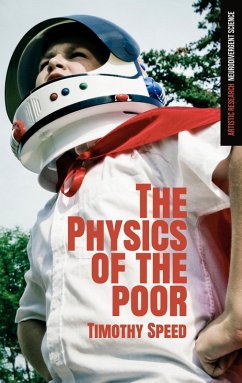
The Physics of the Poor
A Neurodivergent Meta-Theory of Consciousness
Versandkostenfrei!
Versandfertig in 1-2 Wochen
13,99 €
inkl. MwSt.

PAYBACK Punkte
0 °P sammeln!

Whoever possesses objects, products, things - is deemed valuable. Whoever possesses none - is deemed worthless. This was the lived experience of the British-Austrian autistic artist Timothy Speed through many years of poverty. His response was radical: to rewrite physics itself - to base the world not upon things, but upon nothingness. This seemingly small artistic manoeuvre has far-reaching consequences for physics, consciousness research, and the structures of politics, economy, and society. The Physics of the Poor is not an essay, nor a theoretical game - it is a complete, original structur...
Whoever possesses objects, products, things - is deemed valuable. Whoever possesses none - is deemed worthless. This was the lived experience of the British-Austrian autistic artist Timothy Speed through many years of poverty. His response was radical: to rewrite physics itself - to base the world not upon things, but upon nothingness. This seemingly small artistic manoeuvre has far-reaching consequences for physics, consciousness research, and the structures of politics, economy, and society. The Physics of the Poor is not an essay, nor a theoretical game - it is a complete, original structural theory of reality. With the MNO (Minimal Non-Object), the Triad of Submergence, and the All-Nothing Paradox, Timothy Speed formulates a fundamental ontology that does not replace the prevailing models of consciousness (IIT, GNW, SOC), but rather integrates and transcends them on a deeper level. He demonstrates that consciousness cannot be explained as a mere consequence of complexity - but as an emergent decision arising within a structural gap. This work offers a new response to the hard problem of consciousness - no longer asking for the origin of qualia, but for the form of emptiness out of which subjectivity itself arises. The gap becomes the source; nothingness becomes the productive principle. In doing so, Speed interweaves theoretical physics, philosophy, phenomenological experience, and social reality into a coherent metastructure. The Physics of the Poor is a work of artistic research - a radical form of thinking from the boundary: philosophical, political, existential. It introduces not only new concepts but a different epistemology - one emerging from autism, from poverty, from the outside. This book is a rupture with academic habit - and perhaps precisely for that reason, what academia needs now.
Andere Kunden interessierten sich für