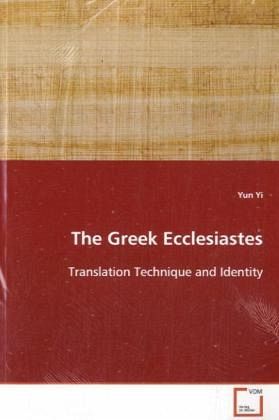
The Greek Ecclesiastes
Translation Technique and Identity
Versandkostenfrei!
Versandfertig in 6-10 Tagen
52,99 €
inkl. MwSt.

PAYBACK Punkte
26 °P sammeln!

The Greek version of the Old Testament, commonlyknown as the Septuagint, is the first biblicaltranslation, but it is not a uniform translation. TheSeptuagint was translated by different translatorsover centuries and shows various translationtechniques from book to book. The varioustranslation techniques form a spectrum ranging fromextreme formal equivalence to a high level offunctional equivalence. No exhaustive study of theGreek Ecclesiastes exists to this point. This bookinvestigates the translation technique of the GreekEcclesiastes and proposes the place of the Translatorin the history of ...
The Greek version of the Old Testament, commonly
known as the Septuagint, is the first biblical
translation, but it is not a uniform translation. The
Septuagint was translated by different translators
over centuries and shows various translation
techniques from book to book. The various
translation techniques form a spectrum ranging from
extreme formal equivalence to a high level of
functional equivalence. No exhaustive study of the
Greek Ecclesiastes exists to this point. This book
investigates the translation technique of the Greek
Ecclesiastes and proposes the place of the Translator
in the history of the transmission of the Greek text.
The author compares and analyzes the Hebrew text of
Ecclesiastes and its Greek translation on syntactical
and lexical levels. The result of the study not only
reveals the characteristics of the translation but
also provides a practical means for comparing the
Greek Ecclesiastes with other Septuagintal books. It
is a work with an impact that cannot be ignored by
any student or scholar desiring to study the
Septuagint.
known as the Septuagint, is the first biblical
translation, but it is not a uniform translation. The
Septuagint was translated by different translators
over centuries and shows various translation
techniques from book to book. The various
translation techniques form a spectrum ranging from
extreme formal equivalence to a high level of
functional equivalence. No exhaustive study of the
Greek Ecclesiastes exists to this point. This book
investigates the translation technique of the Greek
Ecclesiastes and proposes the place of the Translator
in the history of the transmission of the Greek text.
The author compares and analyzes the Hebrew text of
Ecclesiastes and its Greek translation on syntactical
and lexical levels. The result of the study not only
reveals the characteristics of the translation but
also provides a practical means for comparing the
Greek Ecclesiastes with other Septuagintal books. It
is a work with an impact that cannot be ignored by
any student or scholar desiring to study the
Septuagint.
Andere Kunden interessierten sich für