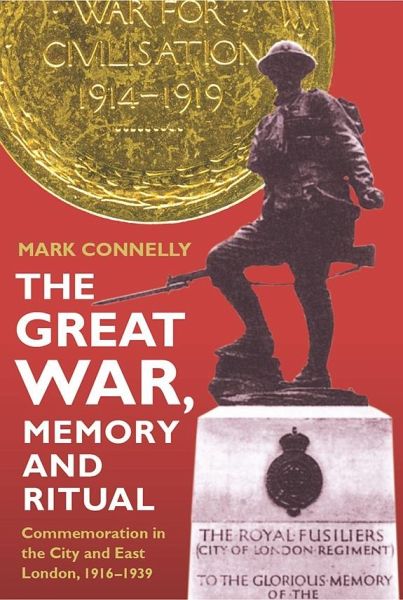
The Great War, Memory and Ritual
Commemoration in the City and East London, 1916-1939
Versandkostenfrei!
Versandfertig in 1-2 Wochen
34,99 €
inkl. MwSt.

PAYBACK Punkte
17 °P sammeln!

This book seeks to question the modern idea that the Great War was regarded as a futile waste of life by British society in the disillusioned twenties and thirties. Through a detailed study of the City and East London localities of widely varying religious, economic and social complexion, it shows how both the survivors and the bereaved came to terms with the losses and implications of the Great War and how communities as diverse as the Irish Catholics of Wapping, the Jews of Stepney and the Presbyterian ex-patriate Scots of Ilford shaped the memory of their dead and created a very definite hi...
This book seeks to question the modern idea that the Great War was regarded as a futile waste of life by British society in the disillusioned twenties and thirties. Through a detailed study of the City and East London localities of widely varying religious, economic and social complexion, it shows how both the survivors and the bereaved came to terms with the losses and implications of the Great War and how communities as diverse as the Irish Catholics of Wapping, the Jews of Stepney and the Presbyterian ex-patriate Scots of Ilford shaped the memory of their dead and created a very definite history of the war. The work concentrates on the planning of, fund-raising for, and erection of war memorials and then goes on to show how those memorials became a focus for a continuing need to remember, particularly each year on Armistice Day. The factors that influenced the nature of these memorials, the iconographic symbols they contained and the associated rituals are analysed: class, religion, political traditions, social and economic influences. The book seeks to show how far the traditional bonds of community in East London were applied to the scale of human loss; how it was explained and made into a comprehensible phenomenon thanks to the actions of the local agents of authority and influence - clergymen, rabbis, councillors, teachers and employers. A detailed case study of the effect of war on a distinct area, it contextualises and in many cases challenges received opinion.
Andere Kunden interessierten sich für