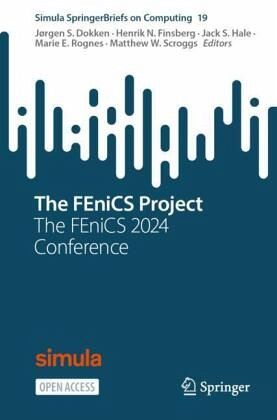
The FEniCS Project
The FEniCS 2024 Conference
Herausgegeben: Dokken, Jørgen S.; Finsberg, Henrik N.; Hale, Jack S.; Rognes, Marie E.; Scroggs, Matthew W.
Versandkostenfrei!
Erscheint vorauss. April 2026
23,99 €
inkl. MwSt.

This open access book provides the reader with a snapshot of the cutting-edge research being undertaken by the members of the FEniCS community, as presented at the FEniCS Conference at Simula Research Laboratory, Oslo, Norway, in June 2024. The conference and this book features contributions from both the developers and users of the library, and includes applications of the software to a wide range of application areas spread throughout engineering, physics and biology. This book highlights topics in all these areas, many of which could not be simulated as efficiently or even simulated at all ...
This open access book provides the reader with a snapshot of the cutting-edge research being undertaken by the members of the FEniCS community, as presented at the FEniCS Conference at Simula Research Laboratory, Oslo, Norway, in June 2024. The conference and this book features contributions from both the developers and users of the library, and includes applications of the software to a wide range of application areas spread throughout engineering, physics and biology. This book highlights topics in all these areas, many of which could not be simulated as efficiently or even simulated at all until recently. The FEniCS Project is an open-source finite element library developed by an international network of researchers. FEniCS gives its users easy access to powerful and scalable numerical tools for solving a great number of problems based on partial differential equations. Its contributions from academia and cutting-edge research mean that many recent algorithmic advances in the area are available in the library. Its open-source nature allows users to freely build their own developments into and on top of the core library, leading to some truly remarkable research. The topics presented in this book are backed up by openly available code examples, to enhance the reproducibility of the results presented within and further development. The target audience of this book is the researcher with an interest in numerical methods, their implementation and application, and the latest up-and-coming areas in which they are being applied.
Andere Kunden interessierten sich für