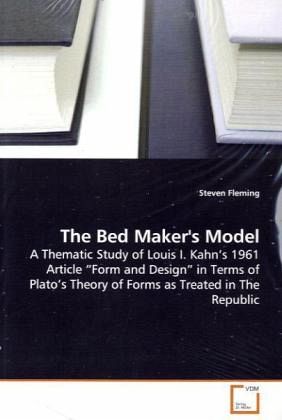
The Bed Maker's Model
A Thematic Study of Louis I. Kahn s 1961 Article Form and Design in Terms of Plato s Theory of Forms as Treated in The Republic
Versandkostenfrei!
Versandfertig in 6-10 Tagen
52,99 €
inkl. MwSt.

PAYBACK Punkte
26 °P sammeln!

In 1960 the theoretical concerns of Americanarchitect Louis I. Kahn began to focus on a concept he called form , notmeaning a building s three dimensional shape, but the essence of itsunderlying type. In The Bed Maker's Model, Steven Fleming asks if Kahn'stheory of "forms" is consistent with Plato s theory of the same name. Thisleads to an examination of the hypothesis that Kahn s interest intranscendent types is reflected in his development of what couldbe called Platonising architectural strategies. While Kahn andPlato are quite different figures, separated by time, profession andintentions,...
In 1960 the theoretical concerns of American
architect Louis I. Kahn
began to focus on a concept he called form , not
meaning a building s
three dimensional shape, but the essence of its
underlying type. In The
Bed Maker's Model, Steven Fleming asks if Kahn's
theory of "forms" is
consistent with Plato s theory of the same name. This
leads to an
examination of the hypothesis that Kahn s interest in
transcendent
types is reflected in his development of what could
be called
Platonising architectural strategies. While Kahn and
Plato are quite
different figures, separated by time, profession and
intentions, the
study illuminates a new interpretation of Kahn's
theory and work,
identifying ideas of Kahn s which resonate with
notions stemming from
the early moments of the Western philosophical tradition.
architect Louis I. Kahn
began to focus on a concept he called form , not
meaning a building s
three dimensional shape, but the essence of its
underlying type. In The
Bed Maker's Model, Steven Fleming asks if Kahn's
theory of "forms" is
consistent with Plato s theory of the same name. This
leads to an
examination of the hypothesis that Kahn s interest in
transcendent
types is reflected in his development of what could
be called
Platonising architectural strategies. While Kahn and
Plato are quite
different figures, separated by time, profession and
intentions, the
study illuminates a new interpretation of Kahn's
theory and work,
identifying ideas of Kahn s which resonate with
notions stemming from
the early moments of the Western philosophical tradition.
Andere Kunden interessierten sich für