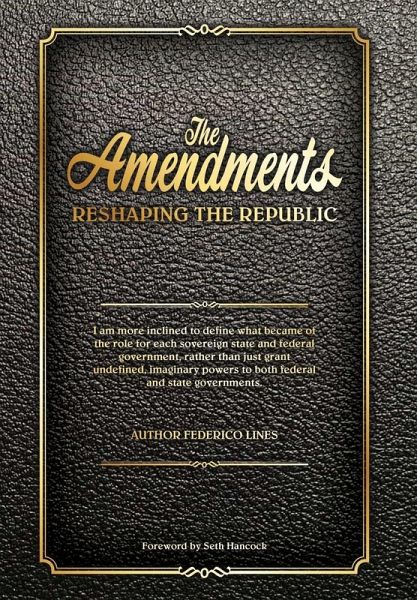
The Amendments
Reshaping the Republic
Versandkostenfrei!
Erscheint vorauss. 31. Januar 2026
30,99 €
inkl. MwSt.

I am deeply ashamed that our American republic-a union of sovereign states-could not end slavery through legislative means. Still, to bring the conflict and its injustices to an end, I am grateful the union passed the Thirteenth Amendment in 1865 through legislative action-not by executive order. After the war and the passage of the Thirteenth Amendment, we hoped to move forward as a more unified, free nation. But that hope quickly faded. Newly freed individuals faced abuse and discrimination worse in many ways than under slavery. To address this, Congress introduced a new amendment to reaffir...
I am deeply ashamed that our American republic-a union of sovereign states-could not end slavery through legislative means. Still, to bring the conflict and its injustices to an end, I am grateful the union passed the Thirteenth Amendment in 1865 through legislative action-not by executive order. After the war and the passage of the Thirteenth Amendment, we hoped to move forward as a more unified, free nation. But that hope quickly faded. Newly freed individuals faced abuse and discrimination worse in many ways than under slavery. To address this, Congress introduced a new amendment to reaffirm the principles of liberty and equality. Thus, came the Fourteenth Amendment in 1868. It was designed to guarantee equality under the law for all Americans, regardless of race or color, and to eliminate the evil of racial privilege. Unfortunately, the promise was betrayed by several states, even the federal government, and unconstitutional rulings from the courts. Which continued to deny equal rights and preserved privilege for some. Over time, new interpretations emerged regarding personal relationships, including indifferent marriage issues, which reshaped the amendment's meaning-not according to its authors, but through modern jurists, politicians, and media voices. One overlooked section of the Fourteenth Amendment is Section III. Which outlines the Congress the power to hold accountable those involved in insurrection and rebellion. This deserves more attention today. Finally, we arrive at the end of the Civil War Amendments: The Fifteenth Amendment, which addressed voting rights in 1870. While I disagree with the national government imposing this right on states-undermining federalism-it became necessary due to widespread discrimination in voting. Though the federal government affirmed the right to vote, states still oversee the voting process. They cannot deny the right to vote based on race, but they retain authority over how votes are cast and counted-a separate issue entirely. These amendments aimed to reshape our republic into a more just and equal union of sovereign states-committed to liberty for all.
Andere Kunden interessierten sich für