Gutscheinbedingungen

**Gültig bis 10.06.2026 / Gültig für gebrauchte Bücher / Mindestbestellwert 20,00 € / Einzelne Artikel können ausgeschlossen sein / Online auf www.bücher.de.de / Nicht kombinierbar mit anderen Gutscheinen oder Preisaktionen / Nur einmal pro Einkauf einlösbar / Gutschein wird auf max. 500€ Bestellwert angerechnet / Keine Barauszahlung / Nicht gültig für Versandkosten und Services

  • Produktbild: Technological Pedagogical Content Knowledge
  • Produktbild: Technological Pedagogical Content Knowledge
- 13%

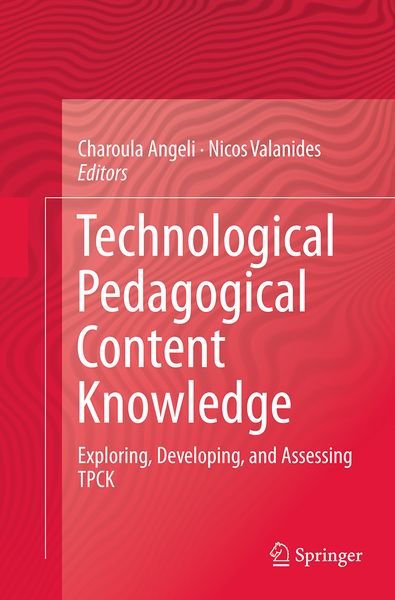
Technological Pedagogical Content Knowledge Exploring, Developing, and Assessing TPCK

13% sparen

92,99 € UVP 106,99 €

inkl. gesetzl. MwSt., Versandkostenfrei

Lieferung nach Hause

Beschreibung

Produktdetails

Einband

Taschenbuch

Erscheinungsdatum

10.09.2016

Abbildungen

XVII, 51 illus., 28 illus. in color., schwarz-weiss Illustrationen, farbige Illustrationen

Herausgeber

Charoula Angeli + weitere

Verlag

Springer Us

Seitenzahl

331

Maße (L/B/H)

23,5/15,5/2 cm

Gewicht

534 g

Auflage

Softcover reprint of the original 1st edition 2015

Sprache

Englisch

ISBN

978-1-4899-7835-6

Beschreibung

Portrait

Dr. Charoula Angeli is Associate Professor of Instructional Technology at the University of Cyprus. She has undergraduate and graduate studies at Indiana University-Bloomington, USA (BS in Computer Science, 1991, MS in Computer Science, 1993 and Ph.D. in Instructional Systems Technology, 1999). Her research interests include the utilization of educational technologies in K-12, the design of computer-enhanced curricula, joint cognitive systems, distributed cognition, technological pedagogical content knowledge, educational software design, teacher training, teaching methodology, online learning and the design of learning environments for the development of thinking skills. Dr. Nicos Valanides is an Associate Professor in the Department of Education at the University of Cyprus.

Produktdetails

Einband

Taschenbuch

Erscheinungsdatum

10.09.2016

Abbildungen

XVII, 51 illus., 28 illus. in color., schwarz-weiss Illustrationen, farbige Illustrationen

Herausgeber

Verlag

Springer Us

Seitenzahl

331

Maße (L/B/H)

23,5/15,5/2 cm

Gewicht

534 g

Auflage

Softcover reprint of the original 1st edition 2015

Sprache

Englisch

ISBN

978-1-4899-7835-6

Herstelleradresse

Springer-Verlag KG
Sachsenplatz 4-6
1201 Wien
AT

Email: ProductSafety@springernature.com

Kundinnen und Kunden meinen

0 Bewertungen

Informationen zu Bewertungen

Zur Abgabe einer Bewertung ist eine Anmeldung im Konto notwendig. Die Authentizität der Bewertungen wird von uns nicht überprüft. Wir behalten uns vor, Bewertungstexte, die unseren Richtlinien widersprechen, entsprechend zu kürzen oder zu löschen.

Die Bewertungen sind nach Format, Anzahl Sterne und Datum sortiert.

Verfassen Sie die erste Bewertung zu diesem Artikel

Helfen Sie anderen Kund*innen durch Ihre Meinung

Kundinnen und Kunden meinen

0 Bewertungen filtern

Weitere Artikel findest du in

  • Produktbild: Technological Pedagogical Content Knowledge
  • Produktbild: Technological Pedagogical Content Knowledge
  • 1. Intro.- Part 1: Toretical Perspectives about the Nature of TPCK.- 2. Re-thinking and Re-representing TPCK: Addressing the complexity of teaching with technology.- 3. Mapping TPACK and the Teacher Knowledge Base: Identifying Common Language, Contexts, and Assessments.- 4: Transforming Teachers’ Knowledge for Teaching in the 21st Century: Advancing Teachers’ Education (Margaret L. Niess, Oregon State University, Oregon, USA). - Part II: Research-Based Perspectives about the Nature of TPCK.- 5: The Essential Role of Pedagogical Knowledge in Technology Integration (Cheryl L. Ward, Susan N. Kushner Benson, and  Xin Liang, University of Akron, USA).- 6: The TPACK-model revisited (Petra Fisser and Joke Voogt, University of Twente, The Netherlands).- 7: Cognitively Representing TPCK – Mental Models of Tool Functions and Cognitive Integration Processes (Karsten Krauskopf, Carmen Zahn, and, Friedrich W. Hesse).- Part III: The Development of TPCK in Pre-service Teacher Education.- 8: Design and implementation of educational activities with the integration of TDCK: a case study of students at a Department of Early Childhood Education (Aggeliki Tzavara and Vasilis Komis, University of Patras, Greece).- 9: A TPACK-Based Instructional Design Model for Preservice Teacher Education (Chia-Jung Lee (Lily), University of Georgia, Georgia, USA).- 10: Intersection and Impact of Universal Design for Learning (UDL) and Technological, Pedagogical, Content Knowledge (TPACK) on 21st Century Teacher Preparation: UDL Infused TPACK Practitioner’s Model (Hope Benton-Borghi, Ohio Dominican University, OH, USA).- 11: Investigating Teaching and Learning Perceptions of Teachers in a Self-Regulated Learning Program for Attaining TPCK (Bracha Kramarski and Tova Michalsky, Bar Ilan University, Israel).- 12: Designing Effective Technology Preparation Opportunities for Preservice Teachers (Chrystalla Mouza and Rachel Karchmer Klein, University of Delaware, Delaware, USA).- 13: TPACKtivity: An Activity Theory Framework for Examining TPACK Development (Marj Terpstra, Calvin College Education Department, MI, USA).- Part IV: The Development of TPCK in Teacher Professional Development Contexts.- 14: Content-Specific Instructional Technology Support: Processes and Perceptions (Sara Dexter, University of Virginia, USA).- 15: A Framework for TPACK-in-Practice: Designing Technology Professional Learning Contexts to Develop Teacher Technology Knowledge (TPACK) (Candace Figg and Kamini Jaipal, Department of Teacher Education, Brock University, Ontario, Canada).- 16: Between the Notion and the Act: Veteran Teachers' TPACK in 1:1 Educational Settings (Lisa Hervey, North Carolina State University, USA).- Part V: The Assessment of TPCK.- 17: Towards Participatory Assessment of TPACK (Barrett and Hickey, Indiana University, Bloomington, Indiana, USA).- 18: Design-thinking Pedagogy and TPACK Assessment among Preservice Teachers ( Bishop and Haley-Mize, University of Southern Mississippi, USA).- 19: Development and assessment of teachers' TPCK-SRL in a video-digital microteaching (Kohen andKramarski, Bar Ilan University, Israel).- 20: The Tacit Dimension of TPACK (Yew, University of Malaysia, Malaysia). - Part VI: TPCK in Content-Specific Contexts.- 21: Pre-Service Teachers’ Developing Knowledge and Beliefs on the use of Technology in the K-12 Mathematics Classroom: Exploratory Analysis using the TPACK Framework ( Crompton, University of North Carolina, USA).- 22: Technological Pedagogical Content Knowledge and the Teaching of Programming (Schulte, Freie Universität Berlin, Germany).- 23: Researching the technology knowledge of office data processing teachers in the context of ict-based classrooms in South Africa fet colleges (Adegbenro).