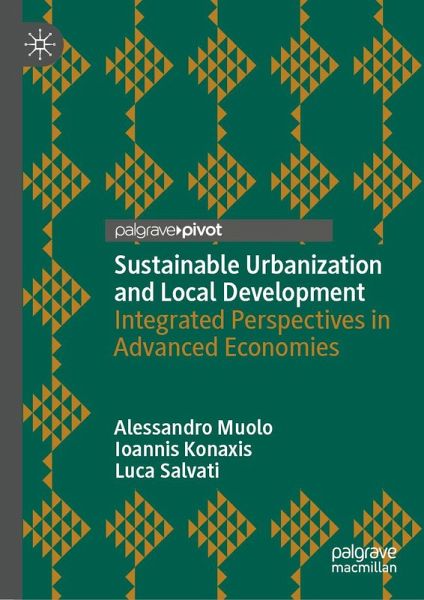
Sustainable Urbanization and Local Development
Integrated Perspectives in Advanced Economies
Versandkostenfrei!
Erscheint vorauss. 27. Februar 2026
26,99 €
inkl. MwSt.

This book seeks a common tread linking economic growth, urban development and environmental sustainability, specifically focusing on urban and metropolitan contexts in developed countries. Starting from a theoretical reflection on capitalistic growth models and the evolution of territorial inequalities, it examines how social and environmental dynamics intersect with economic processes, highlighting the central role of urban areas as innovation, productivity and social transformation engines. It underlines the necessity of new governance strategies aimed at fostering sustainable growth pathway...
This book seeks a common tread linking economic growth, urban development and environmental sustainability, specifically focusing on urban and metropolitan contexts in developed countries. Starting from a theoretical reflection on capitalistic growth models and the evolution of territorial inequalities, it examines how social and environmental dynamics intersect with economic processes, highlighting the central role of urban areas as innovation, productivity and social transformation engines. It underlines the necessity of new governance strategies aimed at fostering sustainable growth pathways, through inclusive public policies and integrated urban tools. The second part of the book delves into the concept of sustainable development within the context of global warming. The phenomenon of urban sprawl is analyzed, with a focus on critical issues related to demographic growth, coastlization and land consumption. It then proposes a polycentric model as an answer to more balanced urban growth. In this framework, territorial economics gains relevance as an emerging tool to study the intricate relationship between competitiveness and sustainability. The analysis starts with describing settlement pattern development and, considering the impact of polycentrism on urban-rural relations, it emphasizes how spatial planning can integrate environmental and economic considerations at various spatial scales. The book concludes with a reflection on social inequalities and the necessity for multilevel governance to sustainably face contemporary urban challenges.
Andere Kunden interessierten sich für