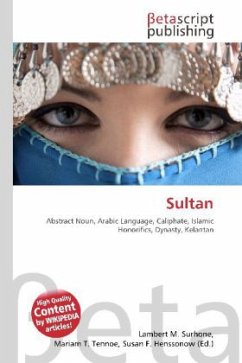
Sultan
Versandkostenfrei!
Versandfertig in 6-10 Tagen
26,99 €
inkl. MwSt.

PAYBACK Punkte
13 °P sammeln!

Please note that the content of this book primarily consists of articles available from Wikipedia or other free sources online. Sultan (Arabic: Sul n) is an Islamic title, with several historical meanings. Originally it was an Arabic language abstract noun meaning "strength", "authority", or "rulership", derived from the masdar sul ah, meaning "authority" or "power". Later, it came to be used as the title of certain Muslim rulers who claimed almost full sovereignty in practical terms (i.e., the lack of dependence on any higher ruler), without claiming the overall Caliphate, or it was used to r...
Please note that the content of this book primarily consists of articles available from Wikipedia or other free sources online. Sultan (Arabic: Sul n) is an Islamic title, with several historical meanings. Originally it was an Arabic language abstract noun meaning "strength", "authority", or "rulership", derived from the masdar sul ah, meaning "authority" or "power". Later, it came to be used as the title of certain Muslim rulers who claimed almost full sovereignty in practical terms (i.e., the lack of dependence on any higher ruler), without claiming the overall Caliphate, or it was used to refer to a powerful governor of a province within the caliphate. It then developed some further meanings in certain contexts. The dynasty and lands ruled by a sultan are referred to as a sultanate (Arabic: ). The title carries moral weight and religious authority, as the ruler''s role was defined in the Qur''an. The sultan however is not a religious teacher himself, and in constitutional monarchies, the sultanship can be reduced to a more limited role.
Andere Kunden interessierten sich für