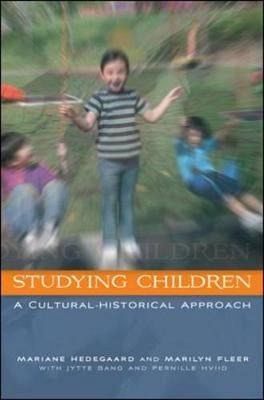
Studying Children
A Cultural-Historical Approach
Versandkostenfrei!
Versandfertig in über 4 Wochen
40,99 €
inkl. MwSt.

PAYBACK Punkte
20 °P sammeln!

Studying Children is the first book of its kind to offer a theoretical and practical discussion of how to undertake research using cultural-historical theory when researching the everyday lives of children.The authors discuss the complexities of child development, providing a critique of alternative perspectives of research and notions of development. They provide a number of case studies following researchers in early childhood as they move from a developmental approach to a cultural-historical framework for observing and planning for young children.The chapters:Provide a solid framework for ...
Studying Children is the first book of its kind to offer a theoretical and practical discussion of how to undertake research using cultural-historical theory when researching the everyday lives of children.
The authors discuss the complexities of child development, providing a critique of alternative perspectives of research and notions of development. They provide a number of case studies following researchers in early childhood as they move from a developmental approach to a cultural-historical framework for observing and planning for young children.
The chapters:
Provide a solid framework for understanding the foundations of this approach
Address the importance of viewing research as an interactive technique
Offer guidance on how to collect and interpret material
Show how to make observations of and interviews with children, within a dialectical research approach
Present examples of how to write and present findings using this technique The book is rich with examples of how to undertake specific methods, such as surveys, experiments, case studies, digital video observations, interviews, and children as researchers.
Studying Children is a valuable resource for academics, researchers and students working in the field of Early and Middle Childhood at both undergraduate and postgraduate level.
The authors discuss the complexities of child development, providing a critique of alternative perspectives of research and notions of development. They provide a number of case studies following researchers in early childhood as they move from a developmental approach to a cultural-historical framework for observing and planning for young children.
The chapters:
Provide a solid framework for understanding the foundations of this approach
Address the importance of viewing research as an interactive technique
Offer guidance on how to collect and interpret material
Show how to make observations of and interviews with children, within a dialectical research approach
Present examples of how to write and present findings using this technique The book is rich with examples of how to undertake specific methods, such as surveys, experiments, case studies, digital video observations, interviews, and children as researchers.
Studying Children is a valuable resource for academics, researchers and students working in the field of Early and Middle Childhood at both undergraduate and postgraduate level.
Andere Kunden interessierten sich für