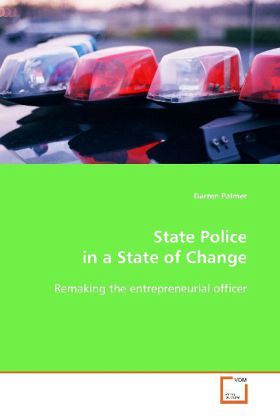
State Police in a State of Change
Remaking the entrepreneurial officer
Versandkostenfrei!
Versandfertig in 6-10 Tagen
52,99 €
inkl. MwSt.

PAYBACK Punkte
26 °P sammeln!

Questions concerning how to govern police practicehave never been more pressing or more fluid. Thisstudy locates contemporary developments in policeaccountability techniques within a broader analysisof the historical circumstances shaping the changingtechniques for governing police. The recentpluralisation of police accountability processes andstructures is examined through the application ofgovernmentality studies. Drawing on a comparativeanalysis of two Australian States the book provides adetailed account of the development of governmentaltechniques for ''making up'' the entrepreneurialoffi...
Questions concerning how to govern police practice
have never been more pressing or more fluid. This
study locates contemporary developments in police
accountability techniques within a broader analysis
of the historical circumstances shaping the changing
techniques for governing police. The recent
pluralisation of police accountability processes and
structures is examined through the application of
governmentality studies. Drawing on a comparative
analysis of two Australian States the book provides a
detailed account of the development of governmental
techniques for ''making up'' the entrepreneurial
officer. While such a governmental project is not
implemented unproblematically the book concludes that
the attempt to shape the development of the
entrepreneurial officer through the managerialisation
of governing presents distinct possibilities for a
new ''politics of policing'' that fosters deliberative
and reflective police practice.
have never been more pressing or more fluid. This
study locates contemporary developments in police
accountability techniques within a broader analysis
of the historical circumstances shaping the changing
techniques for governing police. The recent
pluralisation of police accountability processes and
structures is examined through the application of
governmentality studies. Drawing on a comparative
analysis of two Australian States the book provides a
detailed account of the development of governmental
techniques for ''making up'' the entrepreneurial
officer. While such a governmental project is not
implemented unproblematically the book concludes that
the attempt to shape the development of the
entrepreneurial officer through the managerialisation
of governing presents distinct possibilities for a
new ''politics of policing'' that fosters deliberative
and reflective police practice.
Andere Kunden interessierten sich für