
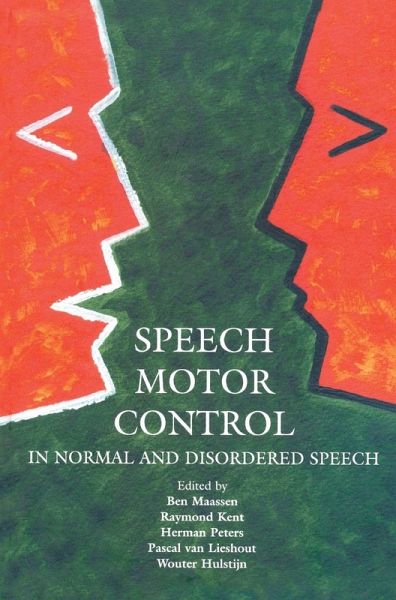
SPEECH MOTOR CONTROL C
Versandkostenfrei!
Versandfertig in 1-2 Wochen
231,99 €
inkl. MwSt.

PAYBACK Punkte
116 °P sammeln!

Key Features:Presents cutting edge research from the field of speech science- Describes the latest theories and clinical developments in speech disorders- Includes important new results from brain imaging studies of speechDescription:Speaking is one of the most complex skills that humans perform. In our everyday communication, we transfer sentences, concepts, thoughts, and ideas. How though, is the speaker able to convert these movements of the speech apparatus? These speech movements are the observable end-product, but what neurological, psycholinguistic, and perceptual-motor processes lie be...
Key Features:Presents cutting edge research from the field of speech science
- Describes the latest theories and clinical developments in speech disorders
- Includes important new results from brain imaging studies of speech
Description:
Speaking is one of the most complex skills that humans perform. In our everyday communication, we transfer sentences, concepts, thoughts, and ideas. How though, is the speaker able to convert these movements of the speech apparatus? These speech movements are the observable end-product, but what neurological, psycholinguistic, and perceptual-motor processes lie behind their production?
To fully understand speech disorders, such as stuttering, apraxia of speech, and Parkinsonian dysarthria, the disruptions in this complex interplay are highly relevant. Equally important is the question of how the infant develops from random babbling to precisely controlled production of words, syllables, and phonemes.
This volume presents state of the art research in the science of speech motor control and speech disorders. All the chapters take a fundamental, model-oriented perspective, as introduced in the first section of the volume. Further topics covered in this book are: brain imaging studies and the rapid progression in comprehending neural mechanisms; developmental studies revealing perceptual-motor continuities and discontinuities; psycholinguistic experimentation showing higher-order influences on speech motor control; and recent notions and applications to the understanding of speech disorders.
This will be an important volume for all those involved in speech research and speech pathology, including those from the disciplines of psychology, neurology and ENT.
Contents:
Part I: Modeling of Speech Production
14. Models of speech motor control
15. A neural model
16. Dynamical systems theory
Part II: Neural Processes
17. Cerebral organization
18. Recent developments in brain imaging
19. Subcortical brain mechanisms
Part III: Speech Motor Developmenet
20. Infants control organs of speech
21. Physiologic development
22. Central pattern generation
Part IV: Interface
23. Interaction of motor and language factors
24. Linguistic processes
Part V: Motor control in disorders
25. Motor control perspectives
26. Recent developments
27. Stuttering and internal models
28. The differential diagnosis of AOS
29. The role of the syllable
- Describes the latest theories and clinical developments in speech disorders
- Includes important new results from brain imaging studies of speech
Description:
Speaking is one of the most complex skills that humans perform. In our everyday communication, we transfer sentences, concepts, thoughts, and ideas. How though, is the speaker able to convert these movements of the speech apparatus? These speech movements are the observable end-product, but what neurological, psycholinguistic, and perceptual-motor processes lie behind their production?
To fully understand speech disorders, such as stuttering, apraxia of speech, and Parkinsonian dysarthria, the disruptions in this complex interplay are highly relevant. Equally important is the question of how the infant develops from random babbling to precisely controlled production of words, syllables, and phonemes.
This volume presents state of the art research in the science of speech motor control and speech disorders. All the chapters take a fundamental, model-oriented perspective, as introduced in the first section of the volume. Further topics covered in this book are: brain imaging studies and the rapid progression in comprehending neural mechanisms; developmental studies revealing perceptual-motor continuities and discontinuities; psycholinguistic experimentation showing higher-order influences on speech motor control; and recent notions and applications to the understanding of speech disorders.
This will be an important volume for all those involved in speech research and speech pathology, including those from the disciplines of psychology, neurology and ENT.
Contents:
Part I: Modeling of Speech Production
14. Models of speech motor control
15. A neural model
16. Dynamical systems theory
Part II: Neural Processes
17. Cerebral organization
18. Recent developments in brain imaging
19. Subcortical brain mechanisms
Part III: Speech Motor Developmenet
20. Infants control organs of speech
21. Physiologic development
22. Central pattern generation
Part IV: Interface
23. Interaction of motor and language factors
24. Linguistic processes
Part V: Motor control in disorders
25. Motor control perspectives
26. Recent developments
27. Stuttering and internal models
28. The differential diagnosis of AOS
29. The role of the syllable
Andere Kunden interessierten sich für