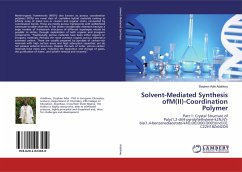
Solvent-Mediated Synthesis ofM(II)-Coordination Polymer
Part 1: Crystal Structure of Poly(1,2-di(4-pyridyl)ethylene-k2N,N')- bis(1,4-benzenediacetato-k4O,O0,O00,O00')zinc(II)], C22H18ZnN2O4
Versandkostenfrei!
Versandfertig in 6-10 Tagen
47,99 €
inkl. MwSt.

PAYBACK Punkte
24 °P sammeln!

Metal-organic frameworks (MOFs) also known as porous coordination polymers (PCPs) are novel class of crystalline hybrid materials existing as infinite array of metal ions or clusters and organic struts, connected by coordination bonds. These are mostly porous frameworks with welldefined nanoscale tunable channels. It has drawn considerable attention because a large number of framework structures of different topologies would be possible to obtain through exploitation of both organic and inorganic components. "Traditionally, porous materials have been either organic or inorganic materials. Perh...
Metal-organic frameworks (MOFs) also known as porous coordination polymers (PCPs) are novel class of crystalline hybrid materials existing as infinite array of metal ions or clusters and organic struts, connected by coordination bonds. These are mostly porous frameworks with welldefined nanoscale tunable channels. It has drawn considerable attention because a large number of framework structures of different topologies would be possible to obtain through exploitation of both organic and inorganic components. "Traditionally, porous materials have been either organic or inorganic materials. Perhaps the most common organic porous material is activated carbon. These are usually prepared by pyrolysis of carbon-rich materials with high surface areas and high adsorption capacities; yet do not possess ordered structures. Despite this lack of order, porous carbon materials have many uses, including the separation and storage of gases, the purification of water, and solvent removal and recovery".
Andere Kunden interessierten sich für