Smart Spectrum Detection for Next-Generation Wireless Systems
Optimizing Wireless Networks Through Smart Spectrum Sensing
Versandkostenfrei!
Versandfertig in 6-10 Tagen
53,99 €
inkl. MwSt.

PAYBACK Punkte
27 °P sammeln!

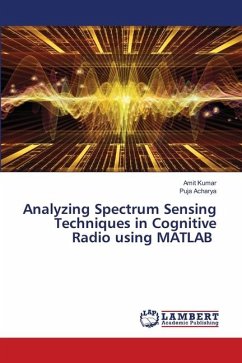
Spectrum sensing plays a vital role in cognitive radio-based wireless communication, as enhanced sensing improves overall network performance. Traditional signal analysis methods like Fast Fourier Transform (FFT) and Wavelet Transform are widely used but have limitations. FFT requires large data samples and high processing time, while Wavelet analysis, though efficient in both time and frequency domains, also demands substantial computation. To address these issues, this study explores the Empirical Mode Decomposition (EMD) technique for spectrum sensing in IEEE 802.22 Wireless Regional Area N...
Spectrum sensing plays a vital role in cognitive radio-based wireless communication, as enhanced sensing improves overall network performance. Traditional signal analysis methods like Fast Fourier Transform (FFT) and Wavelet Transform are widely used but have limitations. FFT requires large data samples and high processing time, while Wavelet analysis, though efficient in both time and frequency domains, also demands substantial computation. To address these issues, this study explores the Empirical Mode Decomposition (EMD) technique for spectrum sensing in IEEE 802.22 Wireless Regional Area Networks (WRAN). The performance of FFT, Wavelet, and EMD-based methods is compared in terms of detection probability, false alarm probability, signal-to-noise ratio, and bit error rate. Simulation and experimental results show that EMD significantly enhances spectrum sensing accuracy and efficiency. Thus, implementing EMD in WRAN improves cognitive radio spectrum detection compared to FFT and Wavelet techniques.
Andere Kunden interessierten sich für