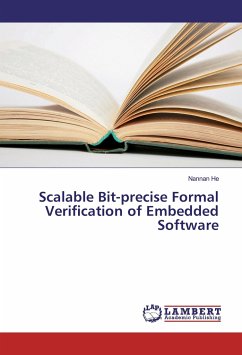
Scalable Bit-precise Formal Verification of Embedded Software
Versandkostenfrei!
Versandfertig in 6-10 Tagen
30,99 €
inkl. MwSt.

PAYBACK Punkte
15 °P sammeln!

Many of the automatic formal verification techniques choose to model a non-Boolean program variable as a bit-vector with bounded width (i.e. a vector of multiple bits like 32- or 64- bits) to achieve bit-precise verification. The major challenge of applying such formal technique to real-world embedded software is scalability. This book explores several abstraction techniques to deal with this challenge. It first proposes a tight integration of program slicing, which is an important static program analysis technique, with bounded model checking. Then it presents a new symbolic simulation for sc...
Many of the automatic formal verification techniques choose to model a non-Boolean program variable as a bit-vector with bounded width (i.e. a vector of multiple bits like 32- or 64- bits) to achieve bit-precise verification. The major challenge of applying such formal technique to real-world embedded software is scalability. This book explores several abstraction techniques to deal with this challenge. It first proposes a tight integration of program slicing, which is an important static program analysis technique, with bounded model checking. Then it presents a new symbolic simulation for scalable formal verification. This simulation involves using distinguishing Xs as symbolic values to abstract concrete variables' values. It also defines two testability metrics - controllability and observability - as the high-level structural guidance to improve efficiency of the proof-based abstraction refinement framework. This book finally proposes a novel algorithm to discover path-oriented non-uniform encoding widths of individual variables, which may be smaller than their original modeling width but large enough for formal verification.
Andere Kunden interessierten sich für