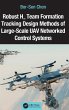

Robust H¿ Team Formation Tracking Design Methods of Large-Scale UAV Networked Control Systems
Versandkostenfrei!
Versandfertig in 6-10 Tagen
80,99 €
inkl. MwSt.
Weitere Ausgaben:

PAYBACK Punkte
40 °P sammeln!

This book introduces the centralized robust H team formation tracking control strategy of multi-unmanned aerial vehicle (multi-UAV) network system under intrinsic random fluctuation, time-varying delay and packet dropout in wireless communication, and external disturbance. A simple robust decentralized H proportional-integral-derivative (PID) reference tracking network control strategy is introduced for practical applications of team formation of large-scale UAV under control saturation constraint, external disturbance, and vortex coupling. It provides practical design procedures based on line...
This book introduces the centralized robust H team formation tracking control strategy of multi-unmanned aerial vehicle (multi-UAV) network system under intrinsic random fluctuation, time-varying delay and packet dropout in wireless communication, and external disturbance. A simple robust decentralized H proportional-integral-derivative (PID) reference tracking network control strategy is introduced for practical applications of team formation of large-scale UAV under control saturation constraint, external disturbance, and vortex coupling. It provides practical design procedures based on linear matrix inequalities (LMIs) solvable via LMI TOOLBOX in MATLAB®.
Features:
Focuses on the stabilization of a QUAV under finite-time switching model control (SMC)
Discusses robustness control design for formation tracking in UAV networks
Introduces different robust centralized and decentralized H attack-tolerant observer-based reference team formation tracking control of large-scale UAVs
Reviews practical case studies in each chapter to introduce the design procedures
Includes design examples of team formation of 25 quadrotor UAVs and a team formation example of five hybrid quadrotor/biped robot sub-teams
This book is aimed at researchers and graduate students in control and electrical engineering.
Features:
Focuses on the stabilization of a QUAV under finite-time switching model control (SMC)
Discusses robustness control design for formation tracking in UAV networks
Introduces different robust centralized and decentralized H attack-tolerant observer-based reference team formation tracking control of large-scale UAVs
Reviews practical case studies in each chapter to introduce the design procedures
Includes design examples of team formation of 25 quadrotor UAVs and a team formation example of five hybrid quadrotor/biped robot sub-teams
This book is aimed at researchers and graduate students in control and electrical engineering.
Andere Kunden interessierten sich für