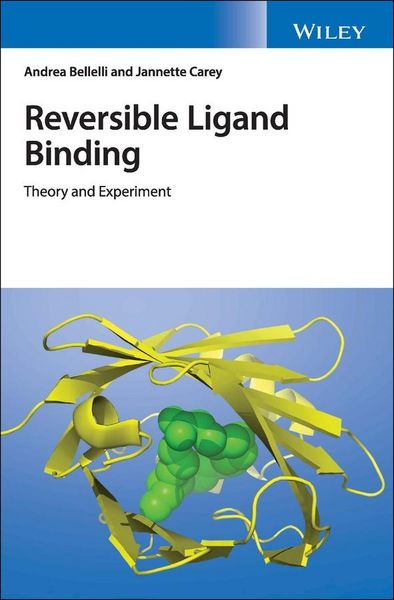
Reversible Ligand Binding Theory and Experiment
131,99 €
inkl. gesetzl. MwSt.,
Lieferung nach Hause
Beschreibung
Produktdetails
Einband
Gebundene Ausgabe
Erscheinungsdatum
09.01.2018
Verlag
John Wiley & SonsSeitenzahl
310
Maße (L/B/H)
25,3/17,7/2,2 cm
Gewicht
635 g
Auflage
1. Auflage
Sprache
Englisch
ISBN
978-1-119-23848-5
Presents the physical background of ligand binding and instructs on how experiments should be designed and analyzed
Reversible Ligand Binding: Theory and Experiment discusses the physical background of protein-ligand interactions--providing a comprehensive view of the various biochemical considerations that govern reversible, as well as irreversible, ligand binding. Special consideration is devoted to enzymology, a field usually treated separately from ligand binding, but actually governed by identical thermodynamic relationships. Attention is given to the design of the experiment, which aids in showing clear evidence of biochemical features that may otherwise escape notice. Classical experiments are reviewed in order to further highlight the importance of the design of the experiment. Overall, the book supplies students with the understanding that is necessary for interpreting ligand binding experiments, formulating plausible reaction schemes, and analyzing the data according to the chosen model(s).
Topics covered include: theory of ligand binding to monomeric proteins; practical considerations and commonly encountered problems; oligomeric proteins with multiple binding sites; ligand binding kinetics; hemoglobin and its ligands; single-substrate enzymes and their inhibitors; two-substrate enzymes and their inhibitors; and rapid kinetic methods for studying enzyme reactions.
* Bridges theory of ligand binding and allostery with experiments
* Applies historical and physical insight to provide a clear understanding of ligand binding
* Written by a renowned author with long-standing research and teaching expertise in the area of ligand binding and allostery
* Based on FEBS Advanced Course lectures on the topic
Reversible Ligand Binding: Theory and Experiment is an ideal text reference for students and scientists involved in biophysical chemistry, physical biochemistry, biophysics, molecular biology, protein engineering, drug design, pharmacology, physiology, biotechnology, and bioengineering.
Reversible Ligand Binding: Theory and Experiment discusses the physical background of protein-ligand interactions--providing a comprehensive view of the various biochemical considerations that govern reversible, as well as irreversible, ligand binding. Special consideration is devoted to enzymology, a field usually treated separately from ligand binding, but actually governed by identical thermodynamic relationships. Attention is given to the design of the experiment, which aids in showing clear evidence of biochemical features that may otherwise escape notice. Classical experiments are reviewed in order to further highlight the importance of the design of the experiment. Overall, the book supplies students with the understanding that is necessary for interpreting ligand binding experiments, formulating plausible reaction schemes, and analyzing the data according to the chosen model(s).
Topics covered include: theory of ligand binding to monomeric proteins; practical considerations and commonly encountered problems; oligomeric proteins with multiple binding sites; ligand binding kinetics; hemoglobin and its ligands; single-substrate enzymes and their inhibitors; two-substrate enzymes and their inhibitors; and rapid kinetic methods for studying enzyme reactions.
* Bridges theory of ligand binding and allostery with experiments
* Applies historical and physical insight to provide a clear understanding of ligand binding
* Written by a renowned author with long-standing research and teaching expertise in the area of ligand binding and allostery
* Based on FEBS Advanced Course lectures on the topic
Reversible Ligand Binding: Theory and Experiment is an ideal text reference for students and scientists involved in biophysical chemistry, physical biochemistry, biophysics, molecular biology, protein engineering, drug design, pharmacology, physiology, biotechnology, and bioengineering.
Kundinnen und Kunden meinen
Verfassen Sie die erste Bewertung zu diesem Artikel
Helfen Sie anderen Kund*innen durch Ihre Meinung
Kurze Frage zu unserer Seite
Vielen Dank für dein Feedback
Wir nutzen dein Feedback, um unsere Produktseiten zu verbessern. Bitte habe Verständnis, dass wir dir keine Rückmeldung geben können. Falls du Kontakt mit uns aufnehmen möchtest, kannst du dich aber gerne an unseren Kund*innenservice wenden.
zum Kundenservice