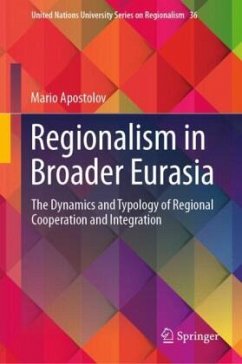
Regionalism in Broader Eurasia
The Dynamics and Typology of Regional Cooperation and Integration
Versandkostenfrei!
Erscheint vorauss. Mai 2026
98,99 €
inkl. MwSt.

Drawing on a wealth of research on regionalism, this book offers a new insight into the role of regional entities as key building blocks of international society after the end of the Cold War. Exploring the dynamic nature of regional relations, the author defines several categories of regions with different forms of cohesion and integration: the EU s top-down model led by visionaries and governments; East Asia s bottom-up approach centred on supply chains rather than institutions; regions limited to only free trade; and, finally, regions without a sense of regionalism such as the Middle East. ...
Drawing on a wealth of research on regionalism, this book offers a new insight into the role of regional entities as key building blocks of international society after the end of the Cold War. Exploring the dynamic nature of regional relations, the author defines several categories of regions with different forms of cohesion and integration: the EU s top-down model led by visionaries and governments; East Asia s bottom-up approach centred on supply chains rather than institutions; regions limited to only free trade; and, finally, regions without a sense of regionalism such as the Middle East. Though the analysis concentrates on the broader Eurasian landmass, it can be applied to all regions and regional integration entities. Challenging notions such as the preponderance of certain forms of regional integration, and investigating the causes and challenges of clashes between different regional integration projects (as in Ukraine), this book concludes with a re-definition of some general principles of regional cooperation and integration. Students of international relations, researchers of regional cooperation and integration from a political science or economic point of view, historians in general, and scholars of international relations theory can all benefit from the insights in this book.
The views expressed in this book are those of the author and do not necessarily reflect the views of the United Nations.
This book offers a clear framework for understanding regionalism. It is essential reading for those seeking insight into the future of international cooperation.
Ivan Krastev
Chairman, Centre for Liberal Strategies, Sofia, Albert Hirschman Permanent Fellow,
Institute for Human Sciences, IWM Vienna
This book by Mario Apostolov explores the contemporary variants ofregionalism in Europe and Asia. From hopefu
The views expressed in this book are those of the author and do not necessarily reflect the views of the United Nations.
This book offers a clear framework for understanding regionalism. It is essential reading for those seeking insight into the future of international cooperation.
Ivan Krastev
Chairman, Centre for Liberal Strategies, Sofia, Albert Hirschman Permanent Fellow,
Institute for Human Sciences, IWM Vienna
This book by Mario Apostolov explores the contemporary variants ofregionalism in Europe and Asia. From hopefu
Andere Kunden interessierten sich für