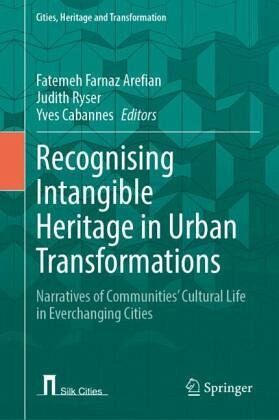
Recognising Intangible Heritage in Urban Transformations
Narratives of Communities' Cultural Life in Everchanging Cities
Herausgegeben: Arefian, Fatemeh Farnaz; Ryser, Judith; Cabannes, Yves
Versandkostenfrei!
Erscheint vorauss. März 2026
113,99 €
inkl. MwSt.

The notion of intangible heritage as a key urban element is underexplored, yet inherently intertwined with urban life that can influence and be influenced by urban policies and practices. This book undertakes the fundamentally interdisciplinary tasks of conceptualizing intangible heritage and recognizing communities' roles as its stewards.From celebration of new years to cultural expressions in daily life, such as religious practices, music and food, intangible heritage is an integral part of communities and individual lives, often considered a natural extension of their being . Cultural pract...
The notion of intangible heritage as a key urban element is underexplored, yet inherently intertwined with urban life that can influence and be influenced by urban policies and practices. This book undertakes the fundamentally interdisciplinary tasks of conceptualizing intangible heritage and recognizing communities' roles as its stewards.
From celebration of new years to cultural expressions in daily life, such as religious practices, music and food, intangible heritage is an integral part of communities and individual lives, often considered a natural extension of their being . Cultural practices are intertwined with human existence. Traditions and cultural expressions do not happen in isolation; they are conditioned by socio-cultural and urban spatiality.
The book offers compelling narratives, explorations, and testimonies on the intangible nature of heritage, and it highlights the challenge of the invisibility of heritage in urban discussions. Thisvolume unpacks links between space, community, and heritage and interconnections between cities, urban characteristics, and the intangible heritage of communities in both normal and disastrous contexts. Contributions offer innovative and exploratory methods and representations of under-explored cases, balancing practical strategies and policy-oriented approaches with storytelling and experiential components.
From celebration of new years to cultural expressions in daily life, such as religious practices, music and food, intangible heritage is an integral part of communities and individual lives, often considered a natural extension of their being . Cultural practices are intertwined with human existence. Traditions and cultural expressions do not happen in isolation; they are conditioned by socio-cultural and urban spatiality.
The book offers compelling narratives, explorations, and testimonies on the intangible nature of heritage, and it highlights the challenge of the invisibility of heritage in urban discussions. Thisvolume unpacks links between space, community, and heritage and interconnections between cities, urban characteristics, and the intangible heritage of communities in both normal and disastrous contexts. Contributions offer innovative and exploratory methods and representations of under-explored cases, balancing practical strategies and policy-oriented approaches with storytelling and experiential components.
Andere Kunden interessierten sich für