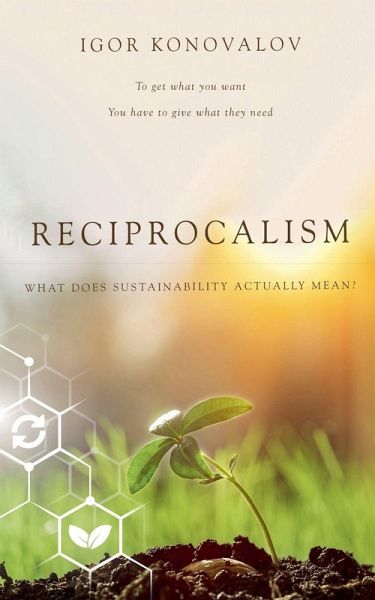
Reciprocalism

PAYBACK Punkte
11 °P sammeln!

To pursue the question, "what does sustainability actually mean?", Reciprocalism deconstructs the very notion of the term to its most essential forms and builds it back up to a practical framework through a series of fundamental rules. Starting from the philosophy of Object-Oriented Ontology, it builds a story of humans and everything around them, both living and non-living. How they interact. Why they interact. What causes interactions to change over time. Through a range of anecdotes and scientific examples, it shows that sustainability is an inherent trait of everything that exists on plane...
To pursue the question, "what does sustainability actually mean?", Reciprocalism deconstructs the very notion of the term to its most essential forms and builds it back up to a practical framework through a series of fundamental rules. Starting from the philosophy of Object-Oriented Ontology, it builds a story of humans and everything around them, both living and non-living. How they interact. Why they interact. What causes interactions to change over time. Through a range of anecdotes and scientific examples, it shows that sustainability is an inherent trait of everything that exists on planet Earth, even of the planet itself. Something so fundamental that it lies beyond the direct control of one individual, or even one species. An emergent property of complex systems. The only way to influence sustainability, is by connecting your own wants and needs to everything around you. Because if you do not make these connections intentionally, they will be made for you regardless. Reciprocalism is a plea for increased collaboration. Not only with other people, but also with nature. It is alright to take something. Even essential. But it is also essential to give something back.
Andere Kunden interessierten sich für