Radar Astronomy
Versandkostenfrei!
Versandfertig in 6-10 Tagen
30,99 €
inkl. MwSt.

PAYBACK Punkte
15 °P sammeln!

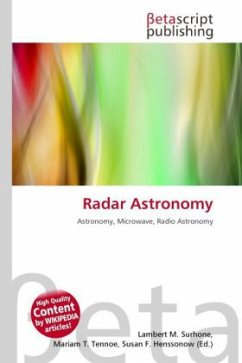
High Quality Content by WIKIPEDIA articles! Radar astronomy is a technique of observing nearby astronomical objects by reflecting microwaves off target objects and analyzing the echoes. This research has been conducted for four decades. Radar astronomy differs from radio astronomy in that the latter is a passive observation and the former an active one. Radar systems have been used for a wide range of solar system studies. The radar transmission may either be pulsed or continuous. The strength of the radar return signal is proportional to the inverse fourth-power of the distance. Upgraded faci...
High Quality Content by WIKIPEDIA articles! Radar astronomy is a technique of observing nearby astronomical objects by reflecting microwaves off target objects and analyzing the echoes. This research has been conducted for four decades. Radar astronomy differs from radio astronomy in that the latter is a passive observation and the former an active one. Radar systems have been used for a wide range of solar system studies. The radar transmission may either be pulsed or continuous. The strength of the radar return signal is proportional to the inverse fourth-power of the distance. Upgraded facilities, increased transceiver power, and improved apparatus have increased observational opportunities. Radar techniques provide information unavailable by other means, such as testing general relativity by observing Mercury and providing a refined value for the astronomical unit. Radar images provide information about the shapes and surface properties of solid bodies, which cannot be obtained by other ground-based techniques.
Andere Kunden interessierten sich für