
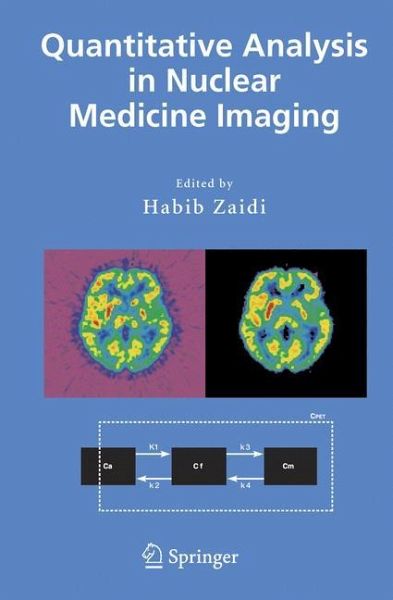
Quantitative Analysis in Nuclear Medicine Imaging
Versandkostenfrei!
Versandfertig in 1-2 Wochen
75,99 €
inkl. MwSt.

PAYBACK Punkte
38 °P sammeln!

This book provides a review of image analysis techniques as they are applied in the field of diagnostic and therapeutic nuclear medicine. Driven in part by the remarkable increase in computing power and its ready and inexpensive availability, this is a relatively new yet rapidly expanding field. Likewise, although the use of radionuclides for diagnosis and therapy has origins dating back almost to the discovery of natural radioactivity itself, radionuclide therapy and, in particular, targeted radionuclide therapy has only recently emerged as a promising approach for therapy of cancer and, to a lesser extent, other diseases. As effort has, therefore, been made to place the reviews provided in this book in a broader context. The effort to do this is reflected by the inclusion of introductory chapters that address basic principles of nuclear medicine imaging, followed by overview of issues that are closely related to quantitative nuclear imaging and its potential role in diagnostic and therapeutic applications.
The different chapters discuss the basic principles and various steps required for obtaining quantitatively accurate data from nuclear medicine images including data collection methods and algorithms used to correct them for physical degrading factors (e.g. collimator response, attenuation, scatter, partial volume effect), and image reconstruction algorithms (analytic, iterative) as well as image processing and analysis techniques as their clinical and research applications in neurology, cardiology and oncology. Some algorithms are described and illustrated with some useful features and clinical applications. Other potential applications of quantitative image analysis such as image-guided radiation therapy are also discussed.
The different chapters discuss the basic principles and various steps required for obtaining quantitatively accurate data from nuclear medicine images including data collection methods and algorithms used to correct them for physical degrading factors (e.g. collimator response, attenuation, scatter, partial volume effect), and image reconstruction algorithms (analytic, iterative) as well as image processing and analysis techniques as their clinical and research applications in neurology, cardiology and oncology. Some algorithms are described and illustrated with some useful features and clinical applications. Other potential applications of quantitative image analysis such as image-guided radiation therapy are also discussed.
This book provides a review of image analysis techniques as they are applied in the field of diagnostic and therapeutic nuclear medicine. Driven in part by the remarkable sophistication of nuclear medicine instrumentation and - crease in computing power and its ready and inexpensive availability, this is a relatively new yet rapidly expanding field. Likewise, although the use of nuclear imaging for diagnosis and therapy has origins dating back almost to the pioneering work of Dr G. de Hevesy, quantitative imaging has only recently emerged as a promising approach for diagnosis and therapy of many diseases. An effort has, therefore, been made to place the reviews provided in this book in a broader context. The effort to do this is reflected by the inclusion of introductory chapters that address basic principles of nuclear medicine instrumentation and dual-modality imaging, followed by overview of issues that are closely related to quantitative nuclear imaging and its potential rolein diagnostic and therapeutic applications. A brief overview of each chapter is provided below. Chapter 1 presents a general overview of nuclear medicine imaging physics and instrumentation including planar scintigraphy, single-photon emission computed tomography (SPECT) and positron emission tomography (PET). Nowadays, patients' diagnosis and therapy is rarely done without the use of imaging technology. As such, imaging considerations are incorporated in almost every chapter of the book. The development of dual-modality - aging systems is an emerging research field, which is addressed in chapter 2.
Andere Kunden interessierten sich für