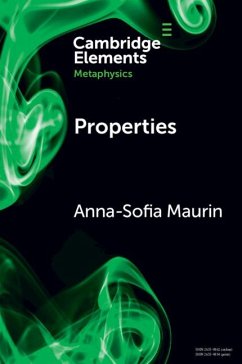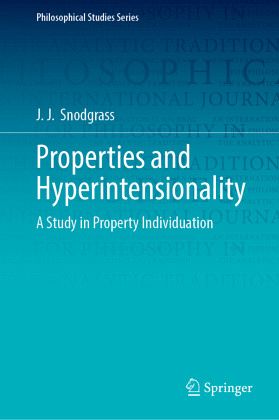
Properties and Hyperintensionality
A Study in Property Individuation
Versandkostenfrei!
Erscheint vorauss. März 2026
98,99 €
inkl. MwSt.

This book develops and defends property hyperintensionalism: a view of individuation according to which properties that have the same instances across all possible worlds can be distinct. Property hyperintensionalism has gained considerable popularity in metaphysics in recent years, largely due to challenges faced by property intensionalism, a rival view that holds that such properties are identical. Yet many metaphysicians remain sceptical of property hyperintensionalism and continue to favour property intensionalism. This book examines and replies to the central objections that have been rai...
This book develops and defends property hyperintensionalism: a view of individuation according to which properties that have the same instances across all possible worlds can be distinct. Property hyperintensionalism has gained considerable popularity in metaphysics in recent years, largely due to challenges faced by property intensionalism, a rival view that holds that such properties are identical. Yet many metaphysicians remain sceptical of property hyperintensionalism and continue to favour property intensionalism. This book examines and replies to the central objections that have been raised against property hyperintensionalism.
The book motivates a new case for property hyperintensionalism by setting out a range of intuitively distinct properties that share all their instances across every possible world, and distinguishes itself by attending to the different relations they bear to one another. It then shows how existing objections to property hyperintensionalism, which include the relational objection by Gonzalo Rodriguez-Pereyra, the multiplication objection by Bart Streumer, the Fregean objection based on Gottlob Frege s theory of meaning, and the restriction objection, do not hold up to scrutiny. The book also develops a series of new objections drawn from Ludwig Wittgenstein's theory of aspect perception and from considerations about necessary connections, principles of parsimony, and degrees of freedom, and shows that these too do not hold up. The book concludes by proposing a novel hyperintensional theory of property individuation. Results are revealed that deliver which properties that have the same instances across all possible worlds are identical and which are not, followed by a showcase as to how the theory resolves two notorious problems that any version of property hyperintensionalism must face: the granularity problem and the difference-maker problem. Applications of the theory are then made to the context sensitivity of similarity judgements, to the sparse-abundant and qualitative-non-qualitative distinctions, and to the concept of naturalness.
This volume will appeal to advanced undergraduate students, graduate students, and professional researchers who work on the topic of hyperintensionalism within metaphysics, philosophy of language, and philosophical logic.
The book motivates a new case for property hyperintensionalism by setting out a range of intuitively distinct properties that share all their instances across every possible world, and distinguishes itself by attending to the different relations they bear to one another. It then shows how existing objections to property hyperintensionalism, which include the relational objection by Gonzalo Rodriguez-Pereyra, the multiplication objection by Bart Streumer, the Fregean objection based on Gottlob Frege s theory of meaning, and the restriction objection, do not hold up to scrutiny. The book also develops a series of new objections drawn from Ludwig Wittgenstein's theory of aspect perception and from considerations about necessary connections, principles of parsimony, and degrees of freedom, and shows that these too do not hold up. The book concludes by proposing a novel hyperintensional theory of property individuation. Results are revealed that deliver which properties that have the same instances across all possible worlds are identical and which are not, followed by a showcase as to how the theory resolves two notorious problems that any version of property hyperintensionalism must face: the granularity problem and the difference-maker problem. Applications of the theory are then made to the context sensitivity of similarity judgements, to the sparse-abundant and qualitative-non-qualitative distinctions, and to the concept of naturalness.
This volume will appeal to advanced undergraduate students, graduate students, and professional researchers who work on the topic of hyperintensionalism within metaphysics, philosophy of language, and philosophical logic.