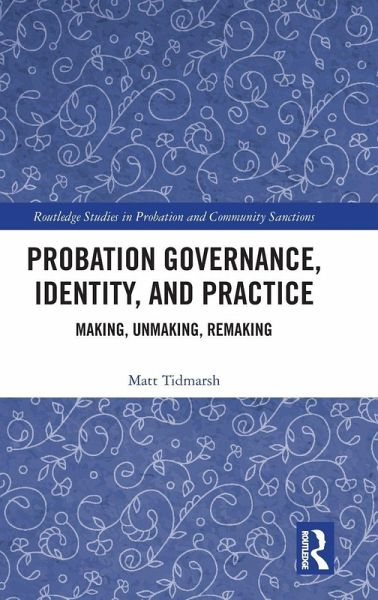
Probation Governance, Identity, and Practice
Making, Unmaking, Remaking
Versandkostenfrei!
Erscheint vorauss. 22. Dezember 2025
161,99 €
inkl. MwSt.
Weitere Ausgaben:

PAYBACK Punkte
81 °P sammeln!

This book explores the making, unmaking, and remaking of the Probation Service in England and Wales - an organisation that, in recent decades, has seemingly been in a constant state of flux. It draws on original empirical data derived from 38 semi-structured interviews with staff from across the probation estate to scrutinise ongoing changes to probation governance, identity, and practice. The book focuses on recent restructurings of probation - namely, the 2014 Transforming Rehabilitation reforms, which resulted in the majority of services being delivered by private providers; and the subsequ...
This book explores the making, unmaking, and remaking of the Probation Service in England and Wales - an organisation that, in recent decades, has seemingly been in a constant state of flux. It draws on original empirical data derived from 38 semi-structured interviews with staff from across the probation estate to scrutinise ongoing changes to probation governance, identity, and practice. The book focuses on recent restructurings of probation - namely, the 2014 Transforming Rehabilitation reforms, which resulted in the majority of services being delivered by private providers; and the subsequent unification, in 2021, when services were returned to the public sector. In this sense, it provides the first monograph-length account of the re-nationalisation of a public service in the UK. Drawing on Michel Foucault's theory of governmentality, it explores how probation governance, identity, and practice have been made, unmade, and remade. In particular, it situates the Probation Service within a neoliberal apparatus of (in)security, a concept that highlights the convergence of heightened punitiveness and managerialism, increased expectations for inter-agency working, and the weakening of the public sector in the UK. The book argues that the Probation Service can, and ought to, perform a civilizing role as an organising 'node' that brings together social welfare, treatment, and community spheres. However, probation's ability to realise this axial role has been undermined by both organisational crisis and the impact of the politics of austerity. This book will be essential reading for students and scholars of criminology. It will also be of interest to practitioners, policymakers, and social workers engaged in probation and welfare services.
Andere Kunden interessierten sich für