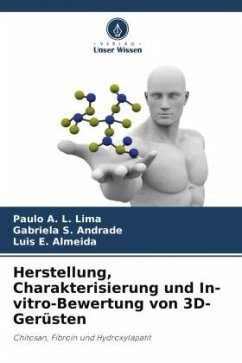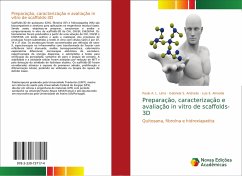
Preparation, characterisation and in vitro evaluation of 3D scaffolds
Chitosan, fibroin and hydroxyapatite
Versandkostenfrei!
Versandfertig in 6-10 Tagen
27,99 €
inkl. MwSt.

PAYBACK Punkte
14 °P sammeln!

3D scaffolds made of chitosan (CHI), fibroin (SF) and hydroxyapatite (HA) are biocompatible and attractive for applications in bone tissue engineering. Therefore, the objective was to prepare, characterise and evaluate the in vitro behaviour of 3D scaffolds made of CHI, CHI/SF and CHI/SF/HA. The biomaterials were produced from a solution of CHI, CHI/SF and CHI/SF/HA in acetic acid and, after the production processes, were subjected to in vitro tests with SaOS-2 cells for 7, 14 and 21 days. The scaffolds were characterised by X-ray diffraction, Fourier transform infrared spectroscopy with atten...
3D scaffolds made of chitosan (CHI), fibroin (SF) and hydroxyapatite (HA) are biocompatible and attractive for applications in bone tissue engineering. Therefore, the objective was to prepare, characterise and evaluate the in vitro behaviour of 3D scaffolds made of CHI, CHI/SF and CHI/SF/HA. The biomaterials were produced from a solution of CHI, CHI/SF and CHI/SF/HA in acetic acid and, after the production processes, were subjected to in vitro tests with SaOS-2 cells for 7, 14 and 21 days. The scaffolds were characterised by X-ray diffraction, Fourier transform infrared spectroscopy with attenuated total reflectance, thermogravimetric analysis, differential scanning calorimetry, scanning electron microscopy, energy dispersive spectroscopy, and tested for porosity, pore size and contact angle. Viability and cellular activity were evaluated by MTT reduction and detection of alkaline phosphatase activity. The 3D scaffolds were considered non-toxic and capable of promoting cell adhesion, proliferation, and differentiation, and can be used in bone defect repair therapy.
Andere Kunden interessierten sich für