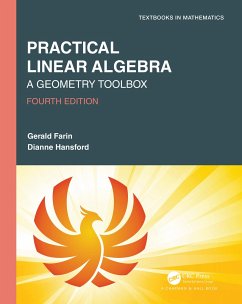
Practical Linear Algebra
A Geometry Toolbox
Versandkostenfrei!
Versandfertig in 6-10 Tagen
62,99 €
inkl. MwSt.

PAYBACK Punkte
31 °P sammeln!

Linear algebra is growing in importance. 3D entertainment, animations in movies and video games are developed using linear algebra. Animated characters are generated using equations straight out of this book. Linear algebra is used to extract knowledge from the massive amounts of data generated from modern technology.The Fourth Edition of this popular text introduces linear algebra in a comprehensive, geometric, and algorithmic way. The authors start with the fundamentals in 2D and 3D, then move on to higher dimensions, expanding on the fundamentals and introducing new topics, which are necess...
Linear algebra is growing in importance. 3D entertainment, animations in movies and video games are developed using linear algebra. Animated characters are generated using equations straight out of this book. Linear algebra is used to extract knowledge from the massive amounts of data generated from modern technology.
The Fourth Edition of this popular text introduces linear algebra in a comprehensive, geometric, and algorithmic way. The authors start with the fundamentals in 2D and 3D, then move on to higher dimensions, expanding on the fundamentals and introducing new topics, which are necessary for many real-life applications and the development of abstract thought. Applications are introduced to motivate topics.
The subtitle, A Geometry Toolbox, hints at the book's geometric approach, which is supported by many sketches and figures. Furthermore, the book covers applications of triangles, polygons, conics, and curves. Examples demonstrate each topic in action.
This practical approach to a linear algebra course, whether through classroom instruction or self-study, is unique to this book.
New to the Fourth Edition:
Ten new application sectionsA new section on change of basis. This concept now appears in several placesChapters 14-16 on higher dimensions are notably revisedA deeper look at polynomials in the gallery of spacesIntroduces the QR decomposition and its relevance to least squaresSimilarity and diagonalization are given more attention, as are eigenfunctionsA longer thread on least squares, running from orthogonal projections to a solution via SVD and the pseudoinverseMore applications for PCA have been addedMore examples, exercises, and more on the kernel and general linear spacesA list of applications has been added in Appendix A
The book gives instructors the option of tailoring the course for the primary interests of their students: mathematics, engineering, science, computer graphics, and geometric modeling.
The Fourth Edition of this popular text introduces linear algebra in a comprehensive, geometric, and algorithmic way. The authors start with the fundamentals in 2D and 3D, then move on to higher dimensions, expanding on the fundamentals and introducing new topics, which are necessary for many real-life applications and the development of abstract thought. Applications are introduced to motivate topics.
The subtitle, A Geometry Toolbox, hints at the book's geometric approach, which is supported by many sketches and figures. Furthermore, the book covers applications of triangles, polygons, conics, and curves. Examples demonstrate each topic in action.
This practical approach to a linear algebra course, whether through classroom instruction or self-study, is unique to this book.
New to the Fourth Edition:
Ten new application sectionsA new section on change of basis. This concept now appears in several placesChapters 14-16 on higher dimensions are notably revisedA deeper look at polynomials in the gallery of spacesIntroduces the QR decomposition and its relevance to least squaresSimilarity and diagonalization are given more attention, as are eigenfunctionsA longer thread on least squares, running from orthogonal projections to a solution via SVD and the pseudoinverseMore applications for PCA have been addedMore examples, exercises, and more on the kernel and general linear spacesA list of applications has been added in Appendix A
The book gives instructors the option of tailoring the course for the primary interests of their students: mathematics, engineering, science, computer graphics, and geometric modeling.
Andere Kunden interessierten sich für