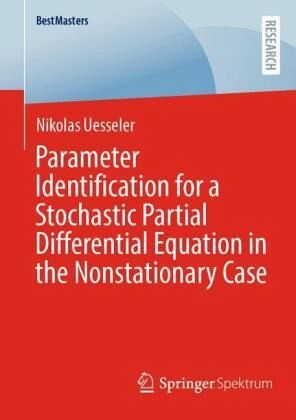
Parameter Identification for a Stochastic Partial Differential Equation in the Nonstationary Case
Versandkostenfrei!
Erscheint vorauss. Januar 2026
65,99 €
inkl. MwSt.

This thesis investigates the mathematical problem of parameter identification in an equation arising from the study of how cells move on an embryo during its development. The motion of the cells can be modeled as particles evolving on a two-dimensional manifold according to a stochastic differential equation. The specific focus here is on estimating the drift parameter of this equation by observing the positions of a finite number of particles at different points in time. The general approach to approximate the solution of this ill-posed problem is to minimize a Tikhonov functional based on a ...
This thesis investigates the mathematical problem of parameter identification in an equation arising from the study of how cells move on an embryo during its development. The motion of the cells can be modeled as particles evolving on a two-dimensional manifold according to a stochastic differential equation. The specific focus here is on estimating the drift parameter of this equation by observing the positions of a finite number of particles at different points in time. The general approach to approximate the solution of this ill-posed problem is to minimize a Tikhonov functional based on a regularized log-likelihood.
To assess the error of this approximation, tools from the theory of ill-posed problems are required. The thesis begins with a chronological review of fundamental results in nonlinear ill-posed problems, with the aim of motivating the assumptions underlying the main result as well as the techniques employed in its analysis from a historical perspective.
To assess the error of this approximation, tools from the theory of ill-posed problems are required. The thesis begins with a chronological review of fundamental results in nonlinear ill-posed problems, with the aim of motivating the assumptions underlying the main result as well as the techniques employed in its analysis from a historical perspective.
Andere Kunden interessierten sich für