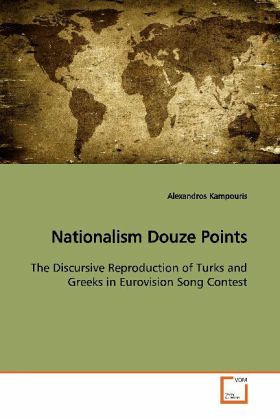
Nationalism Douze Points
The Discursive Reproduction of Turks and Greeks in Eurovision Song Contest
Versandkostenfrei!
Versandfertig in 6-10 Tagen
39,99 €
inkl. MwSt.

PAYBACK Punkte
20 °P sammeln!

The common view holds that Eurovision is a contestaiming to produce cultural uniformity and unable toperform our national distinctiveness. Arguingagainst such a claim, the present study attempts toidentify the ways in which national identities arereproduced on stage by focusing on the Turkish andGreek case. Nationalism is not merely a politicalideology or a stir of irrational feelings but rathera way of thinking which shapes and in turn is shapedby the social milieu. It goes without saying thatnational identities are neither natural facts norfixed but evolving and fluid categories. Departingfr...
The common view holds that Eurovision is a contest
aiming to produce cultural uniformity and unable to
perform our national distinctiveness. Arguing
against such a claim, the present study attempts to
identify the ways in which national identities are
reproduced on stage by focusing on the Turkish and
Greek case. Nationalism is not merely a political
ideology or a stir of irrational feelings but rather
a way of thinking which shapes and in turn is shaped
by the social milieu. It goes without saying that
national identities are neither natural facts nor
fixed but evolving and fluid categories. Departing
from a social constructionist point of view, the
study attempts to examine how Turks and Greeks
particularly produce their identities through the
discursive reproduction of their national myths and
culture. Claims we make about us and others
constitute our identity and signify the
naturalization of nationalism as a particular
language of making sense of the social world.
aiming to produce cultural uniformity and unable to
perform our national distinctiveness. Arguing
against such a claim, the present study attempts to
identify the ways in which national identities are
reproduced on stage by focusing on the Turkish and
Greek case. Nationalism is not merely a political
ideology or a stir of irrational feelings but rather
a way of thinking which shapes and in turn is shaped
by the social milieu. It goes without saying that
national identities are neither natural facts nor
fixed but evolving and fluid categories. Departing
from a social constructionist point of view, the
study attempts to examine how Turks and Greeks
particularly produce their identities through the
discursive reproduction of their national myths and
culture. Claims we make about us and others
constitute our identity and signify the
naturalization of nationalism as a particular
language of making sense of the social world.
Andere Kunden interessierten sich für