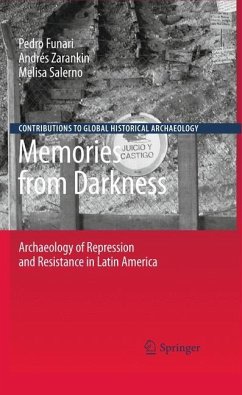


Memories from Darkness
Archaeology of Repression and Resistance in Latin America
Herausgegeben: Funari, Pedro; Zarankin, Andres; Salerno, Melissa

PAYBACK Punkte
19 °P sammeln!

The study of Archaeology in Latin America has been strongly affected by the socio-political setting of the region. The history of military repression in Latin America in the 1960s-1980s has been particularly challenging to study, with many holes in the historic accounts.
Several Latin American dictatorships emerged during this period, particularly during the Cold War and the Cuban Revolution. Military regimes remained in power for decades, until internal and international changes allowed democracy to take over a firm hold.
Due to military and governmental upheaval, written sources on clandestine repression are scarce and fragmentary, with many of these sources destroyed deliberately by repressive governments. New archaeological methods must be employed to reconstruct the true history of this period, helping shed light on repressive mechanisms, to recover missing history.
Not only will the contributions of this important volume shed light on the specific case of Repression in Latin America, but the techniques described will be a valuable resources of information for archaeologists working to reconstruct other historical periods without reliable written sources, and shed light on the nature of political repression worldwide.
Several Latin American dictatorships emerged during this period, particularly during the Cold War and the Cuban Revolution. Military regimes remained in power for decades, until internal and international changes allowed democracy to take over a firm hold.
Due to military and governmental upheaval, written sources on clandestine repression are scarce and fragmentary, with many of these sources destroyed deliberately by repressive governments. New archaeological methods must be employed to reconstruct the true history of this period, helping shed light on repressive mechanisms, to recover missing history.
Not only will the contributions of this important volume shed light on the specific case of Repression in Latin America, but the techniques described will be a valuable resources of information for archaeologists working to reconstruct other historical periods without reliable written sources, and shed light on the nature of political repression worldwide.
To Write What one Could Not Tell Anyone You who live in all tranquility So warm and comfortable in your houses, You who come home at night to find The table laid and friendly faces around you, Consider if this is a man, He who toils in the mud, Who knows no rest, Who fights for a crust of bread, Who dies for the slightest reason. Consider if this is a woman, She who has lost her name and her hair, And even the strength to remember, Her gaze blank and her bosom chilled, Like a frog in winter. Do not forget that this happened, No, do not forget it: Engrave these words in your heart. Think of them in your home, in the street, When you sleep, when you rise; Repeat them to your children. Or else your house will crumble, You will be overcome by illness, And your children will turn away from you (Levi 1987:9, the translations is mine). At Auschwitz, Filip Müller was assigned to the Sonderkommando. Every day, with his fellow prisoners, he emptied the gas chambers of their piles of defiled corpses and loaded them into the crematorium furnaces of the extermination camp.
Andere Kunden interessierten sich für