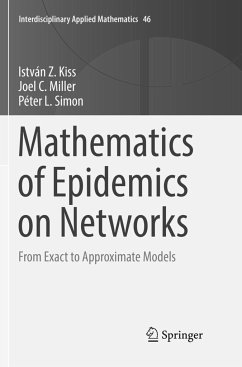
Mathematics of Epidemics on Networks
From Exact to Approximate Models
Versandkostenfrei!
Erscheint vorauss. April 2026
65,99 €
inkl. MwSt.
Weitere Ausgaben:

This textbook provides an exciting new addition to the area of network science featuring a stronger and more methodical link of models to their mathematical origin and explains how these relate to each other with special focus on epidemic spread on networks. The book s content lies at the interface of epidemiology, graph theory, stochastic processes and dynamical systems. This second edition has been substantially expanded from 11 to 15 chapters, adding comprehensive coverage of stochastic models, statistical inference, simple and complex contagions, and higher-order network structures. New ma...
This textbook provides an exciting new addition to the area of network science featuring a stronger and more methodical link of models to their mathematical origin and explains how these relate to each other with special focus on epidemic spread on networks. The book s content lies at the interface of epidemiology, graph theory, stochastic processes and dynamical systems. This second edition has been substantially expanded from 11 to 15 chapters, adding comprehensive coverage of stochastic models, statistical inference, simple and complex contagions, and higher-order network structures. New material reflects recent theoretical advances, while maintaining the unified mathematical framework that made the first edition so valuable. The authors set out to make a significant contribution to closing the gap between model development and the supporting mathematics. This is done by:
Summarising and presenting the state-of-the-art in modeling epidemics on networks with results and readily usable models signposted throughout the book;Presenting different mathematical approaches, including stochastic models, to formulate exact and solvable models;Identifying the concrete links between approximate models and their rigorous mathematical representation;Presenting a model hierarchy and clearly highlighting the links between model assumptions and model complexity;Introducing likelihood-based inference frameworks and Bayesian tools for parameter estimation from real epidemic data;Extending classical network epidemic models to higher-order structures and complex contagion processes;Providing a reference source for advanced undergraduate students, as well as doctoral students, postdoctoral researchers and academic experts who are engaged in modeling stochastic processes on networks;Providing software that can solve differential equation models or directly simulate epidemics on networks.
Replete with numerous diagrams, examples, instructive exercises, and online access to simulation algorithms and readily usable code, this book will appeal to a wide spectrum of readers from different backgrounds and academic levels. Appropriate for students with or without a strong background in mathematics, this textbook can form the basis of an advanced undergraduate or graduate course in both mathematics and other departments alike.
Summarising and presenting the state-of-the-art in modeling epidemics on networks with results and readily usable models signposted throughout the book;Presenting different mathematical approaches, including stochastic models, to formulate exact and solvable models;Identifying the concrete links between approximate models and their rigorous mathematical representation;Presenting a model hierarchy and clearly highlighting the links between model assumptions and model complexity;Introducing likelihood-based inference frameworks and Bayesian tools for parameter estimation from real epidemic data;Extending classical network epidemic models to higher-order structures and complex contagion processes;Providing a reference source for advanced undergraduate students, as well as doctoral students, postdoctoral researchers and academic experts who are engaged in modeling stochastic processes on networks;Providing software that can solve differential equation models or directly simulate epidemics on networks.
Replete with numerous diagrams, examples, instructive exercises, and online access to simulation algorithms and readily usable code, this book will appeal to a wide spectrum of readers from different backgrounds and academic levels. Appropriate for students with or without a strong background in mathematics, this textbook can form the basis of an advanced undergraduate or graduate course in both mathematics and other departments alike.
Andere Kunden interessierten sich für