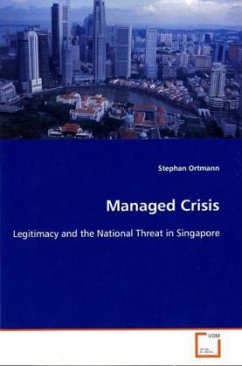
Managed Crisis
Legitimacy and the National Threat in Singapore
Versandkostenfrei!
Versandfertig in 6-10 Tagen
32,99 €
inkl. MwSt.

PAYBACK Punkte
16 °P sammeln!

Following the terrorist attacks of September 11,2001, the United States government has frequentlyrelied on the terrorist threat to justifyrestrictions on personal liberties. This demonstratesthat a threat to the state can legitimizeauthoritarian measures. In the extreme, the nationalthreat can even enable the ruling elite to completelyhollow out a state's democratic institutions as hasbeen the case in Singapore. This book asserts thatSingapore's rulers have consciously used the nationalthreat to legitimize their authoritarian rule. On theone hand, they have stressed the variegated dangersto Si...
Following the terrorist attacks of September 11,
2001, the United States government has frequently
relied on the terrorist threat to justify
restrictions on personal liberties. This demonstrates
that a threat to the state can legitimize
authoritarian measures. In the extreme, the national
threat can even enable the ruling elite to completely
hollow out a state's democratic institutions as has
been the case in Singapore. This book asserts that
Singapore's rulers have consciously used the national
threat to legitimize their authoritarian rule. On the
one hand, they have stressed the variegated dangers
to Singapore's very survival but on the other hand
they have also sought to demonstrate their capability
of managing each of these threats. At the time of
independence, the Communist threat and the threat of
race riots dominated the agenda. This was closely
linked to the threat that the city-state's neighbors,
Indonesia and Malaysia, posed to the security of the
nation. Singapore's rulers have also emphasized the
economic threat that could easily destroy the tiny
state. In recent years, Singapore has also stressed
the dangers of terrorism and communicable diseases
such as SARS.
2001, the United States government has frequently
relied on the terrorist threat to justify
restrictions on personal liberties. This demonstrates
that a threat to the state can legitimize
authoritarian measures. In the extreme, the national
threat can even enable the ruling elite to completely
hollow out a state's democratic institutions as has
been the case in Singapore. This book asserts that
Singapore's rulers have consciously used the national
threat to legitimize their authoritarian rule. On the
one hand, they have stressed the variegated dangers
to Singapore's very survival but on the other hand
they have also sought to demonstrate their capability
of managing each of these threats. At the time of
independence, the Communist threat and the threat of
race riots dominated the agenda. This was closely
linked to the threat that the city-state's neighbors,
Indonesia and Malaysia, posed to the security of the
nation. Singapore's rulers have also emphasized the
economic threat that could easily destroy the tiny
state. In recent years, Singapore has also stressed
the dangers of terrorism and communicable diseases
such as SARS.
Andere Kunden interessierten sich für