rhythms and practices of the everyday means paying attention to the scrutiny of the small and the ordinary, including practices like eating, walking or sleeping. But clearly, the small and the ordinary are not meaningless; quite the contrary, the everyday is political and allows access to the broader world of disability."
Alberto Vanolo (12 Aug 2024):
Learning Disability and Everyday Life,
Disability & Society, DOI: 10.1080/09687599.2024.2391612
"
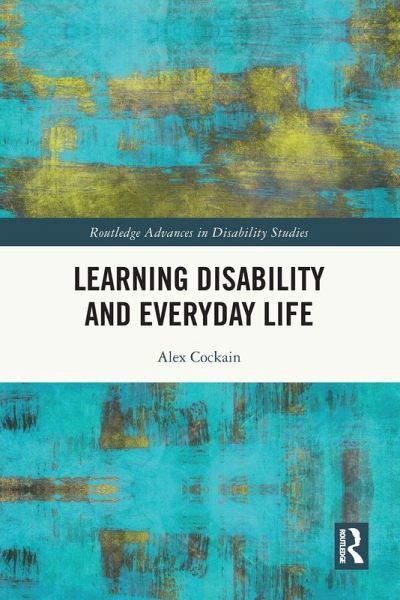
Learning Disability and Everyday Life offers an account of Alex Cockain's life with his brother Paul. Paul is a middle-aged man who has labels of autism and learning disability. The account is ethnographic in texture, and Cockain draws on an impressive array of theory relevant to disability studies including anthropology, sociology, linguistics, phenomenology and a good deal more. He also makes liberal use of disability studies literature in advancing his analysis and arguments. The book shows how apparently mundane moments and practices in Alex and Paul's everyday lives are produced by the hegemonic forces which saturate our social world: D/discourses, power relations, normalcy, ableism and disablism, and so on. In other words, all the usual suspects are here, and they are used to illuminate not just Alex and Paul's everyday lives, but the ways in which other people including neighbours, doctors, and Government bureaucrats respond to autism and learning disability, and people who carry such labels, in their everyday lives.
Ultimately, this book offers a uniquely detailed, textured, erudite and theoretically sophisticated ethnographic case study of two people's everyday lives, and how they are shaped bylearning disability and the sociocultural processes and possibilities that attend it."
Dr. Owen Barden, Review of
Learning Disability and Everyday Life in the
Canadian Journal of Disability Studies 14.1 (April 2025)