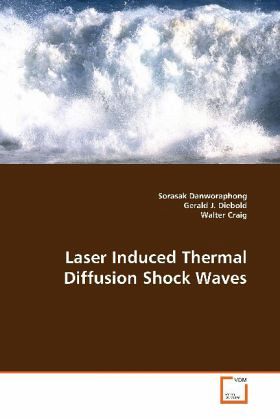
Laser Induced Thermal Diffusion Shock Waves
Theory and Proofs of Their Existence
Versandkostenfrei!
Versandfertig in 6-10 Tagen
32,99 €
inkl. MwSt.

PAYBACK Punkte
16 °P sammeln!

When two phase coherent laser beams are crossed at an angle, the electric fields ofthe beams produce a sinusoidal interference pattern. Partial absorption of the electricfields in a colloidal sample creates a sinusoidal temperature field. The temperaturegradient then causes production of concentration gradient in the sample, known asthe Ludwig-Soret effect or thermal diffusion. Solutions to nonlinear partial differentialequations that describe the effect show that shock waves analogous to fluidshock waves are produced. A mathematical relation between the shock speed and thedensity fraction of ...
When two phase coherent laser beams are crossed at an
angle, the electric fields of
the beams produce a sinusoidal interference pattern.
Partial absorption of the electric
fields in a colloidal sample creates a sinusoidal
temperature field. The temperature
gradient then causes production of concentration
gradient in the sample, known as
the Ludwig-Soret effect or thermal diffusion.
Solutions to nonlinear partial differential
equations that describe the effect show that shock
waves analogous to fluid
shock waves are produced. A mathematical relation
between the shock speed and the
density fraction of one component, analogous to the
well-known Rankine-Hugoniot
equations, is derived. Self-diffraction and imaging
experiments show shock-like behavior
in colloidal systems governed by the thermal
diffusion.
angle, the electric fields of
the beams produce a sinusoidal interference pattern.
Partial absorption of the electric
fields in a colloidal sample creates a sinusoidal
temperature field. The temperature
gradient then causes production of concentration
gradient in the sample, known as
the Ludwig-Soret effect or thermal diffusion.
Solutions to nonlinear partial differential
equations that describe the effect show that shock
waves analogous to fluid
shock waves are produced. A mathematical relation
between the shock speed and the
density fraction of one component, analogous to the
well-known Rankine-Hugoniot
equations, is derived. Self-diffraction and imaging
experiments show shock-like behavior
in colloidal systems governed by the thermal
diffusion.
Andere Kunden interessierten sich für