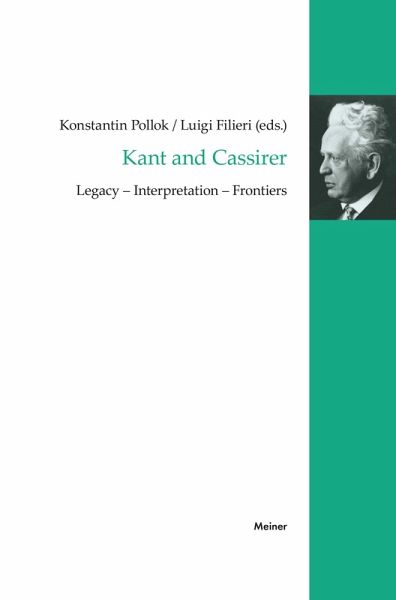
Kant and Cassirer
Legacy - Interpretation - Frontiers
Herausgeber: Pollok, Konstantin; Filieri, Luigi
Versandkostenfrei!
Erscheint vorauss. Februar 2026
78,00 €
inkl. MwSt.

This volume provides a comparative re-evaluation of central aspects of Kant's and Cassirer's philosophical systems. Instead of seeing Cassirer merely as the historian of Kant's philosophy, or as eclectically introducing Kantian themes to his own philosophy of culture, the contributions collected in this volume advance a mutually illuminating account of Kant and Cassirer. This volume aims to foster philosophical discourse at a number of yet unexplored hermeneutic frontiers: from the status and the consistency of our cognitive activities to their relationship with the positive sciences, from the...
This volume provides a comparative re-evaluation of central aspects of Kant's and Cassirer's philosophical systems. Instead of seeing Cassirer merely as the historian of Kant's philosophy, or as eclectically introducing Kantian themes to his own philosophy of culture, the contributions collected in this volume advance a mutually illuminating account of Kant and Cassirer. This volume aims to foster philosophical discourse at a number of yet unexplored hermeneutic frontiers: from the status and the consistency of our cognitive activities to their relationship with the positive sciences, from the nature and value of moral agency to the political and institutional challenges of the contemporary world, and from the dialectic between knowledge and morality to the need of a comprehensive perspective on the whole of human practices. The research interests articulated in these essays thus revolve around three main axes. The first is devoted to Kant's legacy and its presence and role in Cassirer's philosophy; the second focuses on Cassirer's own interpretation, appropriation and development of Kant's critique of reason; the third consists in a philosophical confrontation between Kant and Cassirer connected by the idea that our reason shapes the world we live in, and that this formation process is premised on a moral standpoint.
Andere Kunden interessierten sich für